

Doctrine taught a generation of military leaders the wrong OODA loop. It trains us to think in straight lines, spend on speed, and hand our adversaries the advantage.
Version 1.0, September 2026. This timeline is open. Corrections and additions are welcome, and contributors will be credited.
I’m a retired Navy captain. I served 28 years, nine of them in the cockpit, so let me start with where I learned the OODA loop. Spoiler alert: it wasn’t the cockpit. Contrary to popular belief, the OODA loop is not in the fighter aviation syllabus. It should be, and it should be the real one. I went through JPME I at Air Command and Staff College in 2005-06, then JPME II and JECPC at Norfolk. I earned the Joint Qualified Officer designation. I served in intelligence, on multiple combatant command staffs, at NATO, and inside an Air and Space Operations Center. Almost everywhere I went, the OODA loop was four steps in a line: observe, orient, decide, act, and do it faster than the enemy.
I didn’t learn what sits behind Boyd’s real loop until I left active duty. Around 2015, I was wearing two hats: I was a Navy reservist, and I was working in the Agile industrial complex. In that world I kept seeing the OODA loop connected to Agile, the Lean Startup, Scrum, and a long list of other business management practices. That combination was an invitation to dig deeper into the OODA loop, so I went looking for where it came from. Along the way I saw the real loop put to work exactly once. As a reservist on the PACOM J5 staff, I worked for Russ, a U.S. Air Force colonel and SAMS graduate who had taken the time to learn the real OODA loop from Grant Hammond. Together, Russ and I combined it with the Cynefin framework to guide a resilience wargame. He was the exception that proves the rule. Over time, I found that those business frameworks were built on an incomplete understanding of the OODA loop. Even today, Lean enthusiasts are still putting the linear, four-step OODA loop into their books and papers.
So I decided to take another look at the OODA loop, and what I found might surprise you. The real OODA loop is far more than a four-step process. Learn it, and you are on your way to understanding flow, teamwork, leadership, and why adaptive strategy matters. You will see how elite sports coaches develop skill and teamwork through the Constraints-Led Approach. You will connect mental health to psychological safety and find better ways to reduce employee burnout. You will see the difference between a large language model (LLM) and an active inference agent, and conversations about consciousness will make more sense. You can hold a real conversation about traumatic brain injury and how modalities such as psychedelic-assisted therapies may help mitigate its effects. You will see the market as a complex adaptive system and recognize the fractals in it. You will understand why, in a complex environment, we need to separate decisions from outcomes. Many cognitive warfare discussions will seem irrelevant until their authors read Boyd’s “The Strategic Game of ? and ?” and understand the real OODA loop. With both in hand, cognitive warfare gets a stronger foundation. 4E cognition will make more sense. And you will notice how modern science is converging on Boyd’s real sketch, rediscovering what already exists. In short, you learn the fundamentals of how living systems co-evolve with a changing world, and you gain access to a human performance weapon system. Learn the linear loop instead, and you end up chasing pseudoscience and spending energy and resources on sensors that promise to accelerate your OODA loop. The four-step version belongs on a cocktail napkin, in the same category as Myers-Briggs: well known, and not really useful.
I’m still a student of Boyd’s work. So when I say don’t learn the OODA loop from a military officer, including me, I mean go to the source and check our work. Here is why.
In a recent No Way Out conversation, Oriane Cohen traced the term “cognitive warfare” back to a 1996 American thesis by Arden Dahl. I had never read it, so I went and found it. Maj Dahl wrote “Command Dysfunction: Minding the Cognitive War” at the School of Advanced Airpower Studies at Maxwell during academic year 1995-96. Air University Press published it in 1998.
Dahl builds his framework on a four-step OODA loop. His Figure 2, the loop itself, is credited to Joint Publication 3-13.1. So I went to JP 3-13.1.
The first Joint Publication with the loop
JP 3-13.1, Joint Doctrine for Command and Control Warfare, is dated 7 February 1996. Appendix A, “The Decision Cycle,” says its model “is based upon the Observe, Orient, Decide, and Act loop.” Boyd is not named. Figure A-1 is a circle with one arrow between each step.

In the orientation phase, the intelligence staff converts information into intelligence, and the commander forms an assessment of the “reality” of the operational area. The length of the arc between steps represents time. The commander who acts quickest gains the advantage, and getting inside the adversary means making your cycle smaller than his.
The appendix’s best paragraph calls the cycle “a continuous process rather than a step-by-step process,” with all parts active at the same time. Read that paragraph alone and you are halfway to Boyd. The figure is what traveled.
What Boyd actually drew
Boyd’s A Discourse on Winning and Losing (August 1987) includes “Patterns of Conflict” and “An Organic Design for Command and Control.” Both describe observation, orientation, decision, and action in words. Neither contains a loop drawing. Grant Hammond’s 2018 Air University Press edition confirms that the sketch is absent from the 1987 version.
The words, though, already put orientation at the center. In Organic Design, Boyd describes orientation two ways. Seen as a result, it “represents images, views, or impressions of the world shaped by genetic heritage, cultural tradition, previous experiences, and unfolding circumstances.” Seen as a process, it is “an interactive process of many-sided implicit cross-referencing projections, empathies, correlations, and rejections.” Then he names its place in the loop: “Orientation is the Schwerpunkt. It shapes the way we interact with the environment, hence orientation shapes the way we observe, the way we decide, the way we act.” Finally he closes the circle: orientation shapes the loops we run now, and those loops shape the orientation we carry forward. In a recorded briefing, he put it plainly. You can look at orientation as a result, but it is really an ongoing process that keeps getting tweaked and tuned.
The only OODA loop sketch Boyd ever published is the diagram in “The Essence of Winning and Losing,” dated 28 June 1995. He worked through drafts before he landed on it, and that diagram is the one he put his name on. There is no OODA loop sketch from the 1950s, the 1960s, the 1970s, or the 1980s. It did not come out of a fighter cockpit. Anyone selling you the story that fighter pilots run on the OODA loop is selling you folklore. I know a lot of fighter pilots, and very few of them can explain the OODA loop. That matters now that some of them work for AI companies, chasing closed-system ideas built around the linear, four-step loop. Boyd’s fighter-era work produced the “Aerial Attack Study” and energy-maneuverability theory, and neither contains the loop. The loop entered his briefings in words, and the drawing came at the end of his career, less than two years before he died.
The diagram draws what the 1987 words already said. Orientation sits at the center. It shapes observation, decision, and action, and feedback runs back into it. Implicit guidance and control runs straight from orientation to action. Boyd died on 9 March 1997.

JP 3-13.1 is dated 7 February 1996, about seven months after the date on Boyd’s diagram. Appendix A shows no trace of it.
So I looked wider
Here is what the joint and Service publications show. The timeline graphic lays out the whole trail.
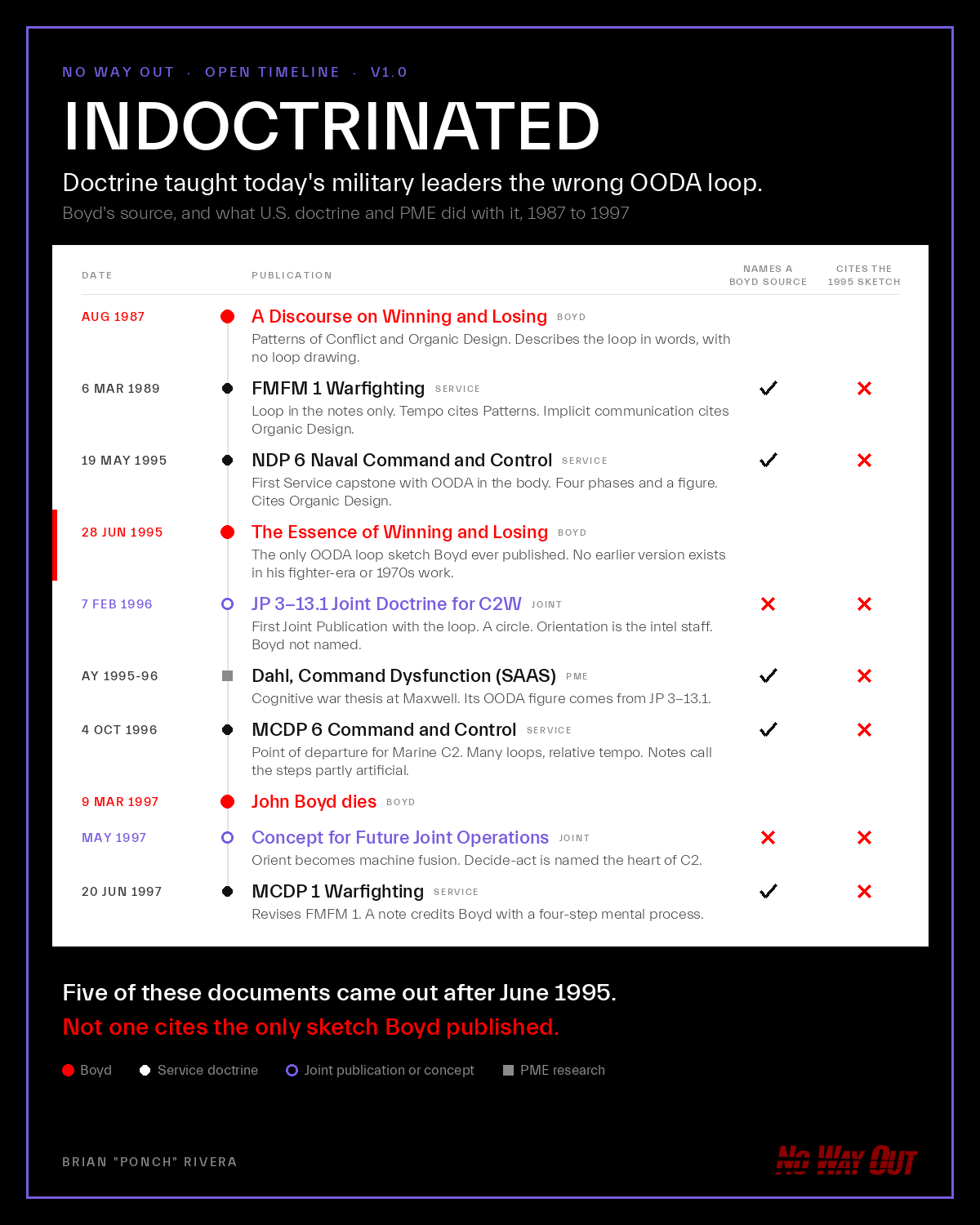
FMFM 1 Warfighting (6 March 1989). Capt John Schmitt drafted it for Gen Al Gray. The loop stays in the notes. Tempo cites Patterns of Conflict, and implicit communication cites Organic Design.
NDP 6 Naval Command and Control (19 May 1995). This is the first Service capstone to put the loop in the body: “The Decision and Execution Cycle,” four phases, and a figure. It cites Organic Design, which has no loop drawing. Doctrine drew its own picture about six weeks before the date on Boyd’s.
MCDP 6 Command and Control (4 October 1996). The loop becomes the point of departure for Marine command and control. The body gets real things right: many loops at once, tempo relative to the enemy, and meaningful action over mere speed. The notes cite Patterns, Organic Design, and Wiener on feedback, and admit that dividing command and control into neat sequential steps is partly artificial. The body still calls the loop “the basic sequence of the command and control process.”
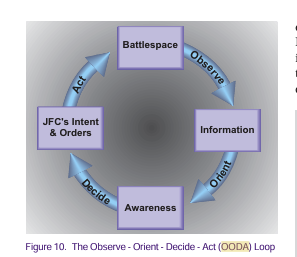
Concept for Future Joint Operations (May 1997). This joint concept paper expands Joint Vision 2010. It prints Figure 10, “The Observe–Orient–Decide–Act (OODA) Loop,” and does not name Boyd. Orient becomes analysis and fusion “using the power of digitization and the microprocessor.” The paper calls the decide-act link “the true heart of the C2 function.”
MCDP 1 Warfighting (20 June 1997). This revises FMFM 1 and keeps its pattern. A note says Boyd “identified a four-step mental process.”
Add it up and you get four problems. The loop is drawn as four steps in every figure. The references are bad where they exist, since MCDP 1 credits Boyd with a sequence his briefs do not describe. In the joint line the references do not exist at all, because JP 3-13.1 and CFJO never name him. And not one of these publications cites the only sketch Boyd ever published.
Boyd’s ideas and words were never missing. NDP 6 and MCDP 6 both cite Organic Design, the brief where Boyd calls orientation the Schwerpunkt and says it shapes the way we observe, decide, and act. Doctrine cited that brief and drew four equal boxes anyway. JP 3-13.1 went further and handed orientation to the intelligence staff. Boyd’s list starts with genetic heritage and cultural tradition, and neither one fits inside a staff section.
The wrong loop is still being taught
You might expect doctrine to catch up once Boyd’s diagram was available. It has not. No capstone Joint or Service publication has adopted the Essence diagram as its command and control figure. Later doctrine either kept the four-step cycle, dropped the word OODA for new labels, or left the real sketch to journals and concept papers.
In the 2000s, the JP 3-13 family replaced JP 3-13.1, MCDP 1 and MCDP 6 remained the Marine capstones, and the Army moved to mission command in FM 6-0. “Decision cycle” shows up now and then. The word OODA rarely does, and when a figure appears, it is the four-box loop.
In the 2010s, ADP 6-0 (2012 and 2019) set out mission command and the command and control warfighting function. JP 3-0 and JP 5-0 went through revisions built around the operations process. None of them installed Boyd’s diagram.
In the 2020s, the language turned to JADC2, decision advantage, and speed against the adversary. The Department of Defense’s 2022 JADC2 strategy summary frames command and control as sense, make sense, and act, which is another cycle with no orientation at its center. Army Futures Command Pamphlet 71-20-9 (2021) introduced a new cycle: sense and understand, decide, act, and assess. Each step carries a goal. Sense and understand means knowing ourselves, our adversaries, and the operational environment. Decide means achieving decision advantage. Act means seizing, retaining, and exploiting the operational initiative. It is a better-labeled cycle, and it still has no center. Orientation, the part Boyd said shapes everything else, does not appear.
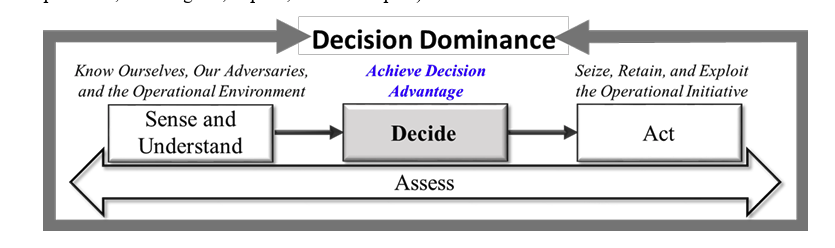
The irony runs deep. In the November-December 2022 issue of Military Review, Maj Christopher Kean, U.S. Air Force, makes the case for the real loop in “Conceptualizing Information Advantage Using Boyd’s OODA Loop,” and prints the expanded version from the Discourse. He sets Boyd’s loop next to the Army’s new cycle, and the comparison shows exactly what the new cycle leaves out: orientation. Kean describes orientation as the blend of genetic heritage, cultural traditions, previous experience, education, and new information, a complex set of filters that condition action and reaction. He points out that orientation guides and controls how people observe and act, and that it nests with the Army’s own idea of the human dimension in the draft ADP 3-13, which covers individual reasoning, emotion, and behavior along with culture, group identity, and social power dynamics. Kean also notes that Boyd originally planned to use “sense” instead of “observe,” and dropped it because a “SODA loop” would carry less credibility. Twenty-five years after Boyd’s death, the Army’s new cycle starts with sense and still leaves out orientation.
The real sketch does exist in official print, just not where most officers learn command and control. Air University Press bound “The Essence of Winning and Losing” into Hammond’s 2018 edition of the Discourse. Kean’s article carries it. SAMS and SAW monographs, the Marine Corps Gazette, Air University journals, and NATO papers show it too, often with a note that doctrine oversimplified it. Even then the diagram can get the old treatment: I have seen a recent NATO paper print the right image and then describe it as a linear sequence.
So a colonel or a general reading doctrine today finds a simple cycle, “decision superiority,” or a new Army graphic. They will not find implicit guidance and control, and they will not find orientation at the center. Boyd’s diagram has been available for more than thirty years. Since 2018 it has sat in an Air University Press book that anyone can read online for free. Doctrine has never swapped its loop for it.
Why this matters
For thirty years we taught four boxes in place of the simplest picture anyone has drawn of how a living system engages a changing world, and every field that depends on adaptation paid for it.
The diagram represents that engagement on one page. The explanation lives in Boyd’s corpus, A Discourse on Winning and Losing, which draws together neuroscience, systems thinking, cybernetics, quantum physics, and more. Put the sketch and the Discourse together and you have what I call Boyd’s real OODA loop. The real OODA loop shows why a team with a shared orientation moves without waiting for orders, and why the real target in warfare and cognitive warfare is what the adversary expects to see. It accounts for entrainment. On The Joe Rogan Experience #2553 (September 14, 2026), neuroscientist Andrew Huberman described how people entrain their attention to a rhythm of distraction, reaching for a phone every few minutes even when it isn’t there. That is orientation shaping observation. He also said the adult brain changes through focused effort and error rather than passive experience: “The error signal is what instructs the brain to change.” Boyd would call that a mismatch forcing reorientation. All of that was available in 1995, and doctrine handed us four boxes.
Here is the part that should bother every one of us. The four-step loop entrains the people who learn it. In that version, orientation is a box you pass through on the way to a decision, so nothing in the model asks you to update your own orientation. You learn it at staff college, you see it again in every briefing, and your attention locks onto it. No error signal ever arrives, because the model never tells you to look for one. That is entrained thinking, and it explains why so many sharp officers never go looking for Boyd’s sketch. I know, because I was one of them. Breaking it takes the thing Huberman described: an error signal. You have to set what you learned next to what Boyd drew, and let the mismatch do its work.
The people carrying the four boxes now run the force. Intermediate staff college, JPME I, typically comes at O-4 with ten to twelve years of service. Under DOPMA-style timing, O-6 comes around 21 to 23 years, and flag and general officer selection follows for a few. An officer who went through staff college between the late 1990s and 2010 is today a senior colonel or captain, or a one- or two-star, or higher. I’m one of them: Air Command and Staff College, class of 2006. My classmates are running wings, brigades, carrier strike groups, and joint task force staffs.
JPME policy never required anyone to teach Boyd or the OODA loop. It required joint command and control, planning, and doctrine. The loop came into the classroom riding on doctrine, and the doctrine those officers read is the list above. Some of them know the real sketch: Marines who read the MCDP 6 notes closely, SAMS and SAAS graduates like Russ, and people who later read Osinga or Richards. For most of that cohort, the reasonable default is the four-step speed loop. It was mine.
That default shapes decisions. If you believe the loop is four steps and the winner is the fastest, you invest in sensors, fusion, and faster decision pipelines. Orientation, which means culture, training, experience, and the thing that decides what all that data means, becomes someone else’s problem. CFJO wrote that instinct down in 1997. You can still hear it every time someone promises to “accelerate the OODA loop.” It is like buying a faster car when the map is wrong. An entrained organization will keep buying faster cars, because nothing in its model tells it to check the map.
This timeline is open
I want this timeline to be as accurate as possible, which means other people need to check it. It is version 1.0, and here is what would make it better:
- Publications I missed: Army, Air Force, joint, allied, and NATO, especially anything that draws or cites the loop before 2000.
- Staff and war college materials: syllabi, readings, or slides from 1990 to 2010 that show how the loop was taught.
- Your own memory of it: if you went through staff college in that window, what were you taught the OODA loop was, and did anyone show you the diagram from “The Essence of Winning and Losing”?
- Corrections: if I have a date, a citation, or a reading wrong, tell me and show me the source.
I will update the timeline and credit everyone who contributes.
Think of this timeline as your error signal. Updating your orientation on the OODA loop starts the same way Boyd said all reorientation starts: with a mismatch you can’t explain away. Go to the source. Grant Hammond’s edition of A Discourse on Winning and Losing is published by Air University Press, and you can read it online for free. Put the Essence diagram next to the four boxes you learned. Start there, and skip the four boxes.
Sources
- John R. Boyd, A Discourse on Winning and Losing, ed. Grant T. Hammond (Maxwell AFB, AL: Air University Press, published 1 March 2018). Includes “Patterns of Conflict,” “An Organic Design for Command and Control,” and “The Essence of Winning and Losing” (28 June 1995). Free PDF. The errata for page 384, which carries the real OODA loop sketch, is available for download on the same Air University Press page.
- Arden B. Dahl, Command Dysfunction: Minding the Cognitive War, School of Advanced Airpower Studies thesis, academic year 1995-96 (Maxwell AFB, AL: Air University Press, 1998).
- Joint Publication 3-13.1, Joint Doctrine for Command and Control Warfare (C2W), 7 February 1996, Appendix A.
- FMFM 1, Warfighting, Headquarters U.S. Marine Corps, 6 March 1989.
- NDP 6, Naval Command and Control, 19 May 1995.
- MCDP 6, Command and Control, Headquarters U.S. Marine Corps, 4 October 1996.
- Concept for Future Joint Operations: Expanding Joint Vision 2010, May 1997.
- MCDP 1, Warfighting, Headquarters U.S. Marine Corps, 20 June 1997.
- ADP 6-0, Mission Command, Headquarters Department of the Army, 2012 and 2019.
- Army Futures Command Pamphlet 71-20-9 (2021).
- Maj Christopher Kean, USAF, “Conceptualizing Information Advantage Using Boyd’s OODA Loop,” Military Review, November-December 2022.
- Department of Defense, Summary of the Joint All-Domain Command and Control (JADC2) Strategy, March 2022.
- The Joe Rogan Experience #2553, with Andrew Huberman, September 14, 2026.
- No Way Out conversation with Oriane Cohen.
Brian “Ponch” Rivera is a retired U.S. Navy captain and a TOPGUN-trained F-14 RIO. He is co-creator of The Flow System, co-founder and CEO of AGLX Consulting, and co-host of the No Way Out podcast.