

John Boyd’s bibliography, library, margin notes, and typed drafts show where his OODA loop came from, and how he rewired the cybernetics he borrowed.
On September 22, President Trump told the United Nations General Assembly that U.S. government documents would stop saying “artificial intelligence” and say “super intelligence” instead. He said the new name “sounds much better” and is “much more accurate.”
Two days later, Maxwell Ramstead, a free energy principle researcher who has published with Karl Friston, offered a different name on X. “Cybernetic control system,” he wrote, has “the great advantage of being descriptive” and avoids “the dangerous kind of semantic drift and hype-proneness that you get from the term ‘artificial intelligence.’” Then, shorter: “can we just go back to calling it cybernetics please.”
Ramstead’s post hit close to home. Boyd’s real OODA loop, the one Karl Friston heard us walk through on No Way Out and called “isomorphic with active inference,” grew out of the same cybernetics as Friston’s free energy principle. Boyd worked his loop out in the margins of other authors’ books, in his own notes, and in his briefings, over two decades. He read widely and argued with the authors as he went. He finished Destruction and Creation fifty years ago this month, then kept reading and writing for nineteen more years before he published the OODA loop sketch in 1995. In one of those margins he even drew a line through the word.
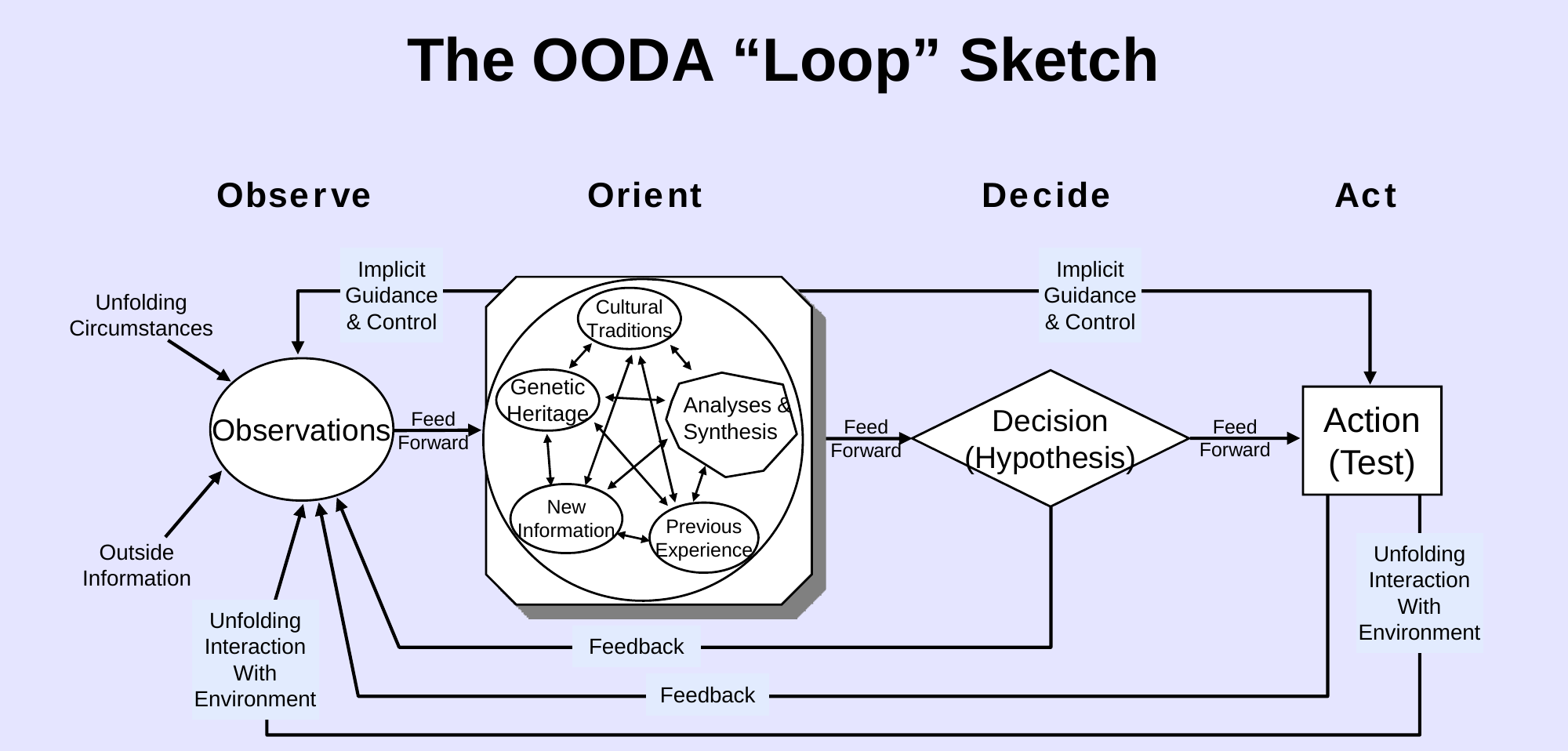
In 1948 Norbert Wiener named a new science and gave it a subtitle that told you exactly what it was about: Cybernetics: Or Control and Communication in the Animal and the Machine. Forty-seven years later, John Boyd published his only sketch of the OODA loop. Look at the labels on his arrows. Feedback. Implicit Guidance and Control. Unfolding Interaction with Environment. Those are Wiener’s words.
Most people never see those labels. They learned the four-step, linear OODA loop instead: observe, orient, decide, act, repeat. That version is a checklist with a return arrow. Boyd’s sketch shows how a living system stays coupled to its world, and the clearest way to see that is to follow his trail into cybernetics.
Where he found it
The trail starts in an odd place. The bibliography of Destruction and Creation, the 1976 paper that is the foundation for understanding the OODA loop, lists Maxwell Maltz’s Psycho-Cybernetics. Maltz was a plastic surgeon who wrote a self-help book about the mind as a goal-seeking servomechanism. Boyd’s door into one of the big ideas of the twentieth century was a paperback off a drugstore rack. I find that encouraging.
His copy is still at Quantico, a two-dollar Wilshire paperback. In Melvin Powers’s foreword, Boyd underlined one paragraph in blue ballpoint, every line of it. It says Wiener “had used a feedback mechanism in guns and missiles to preclude error,” and reasoned that a man could reach his goal “by the same mechanism, translated into human terms.” That is the first wave of cybernetics in two sentences, and Boyd found it on page IX of a self-help book.
He kept going. The same bibliography lists G. Spencer Brown’s Laws of Form, a book the second wave of cyberneticians adopted as a working text on observers and distinctions. Frans Osinga, whose Science, Strategy and War is still the best map of the sources behind Boyd’s thinking, found cybernetics all through the personal papers: F. H. George’s Cybernetics, Y. Sabarina’s Cybernetics Within Us, U. S. Anderson’s Success-Cybernetics, a book on biofeedback, and Wiener’s own The Human Use of Human Beings. George and Maltz are both still on the shelf at the Marine Corps History Division, and I have photographed both.
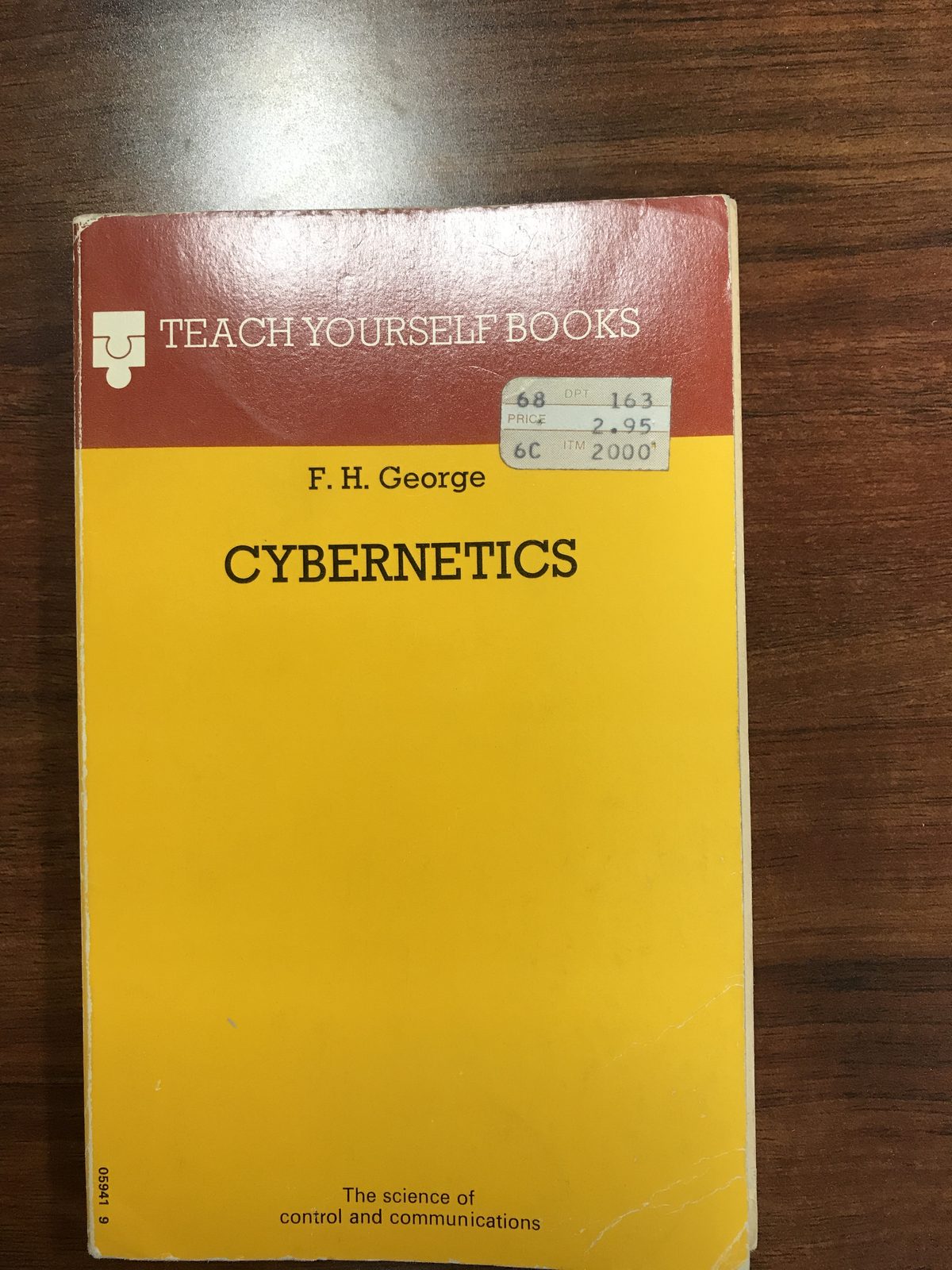
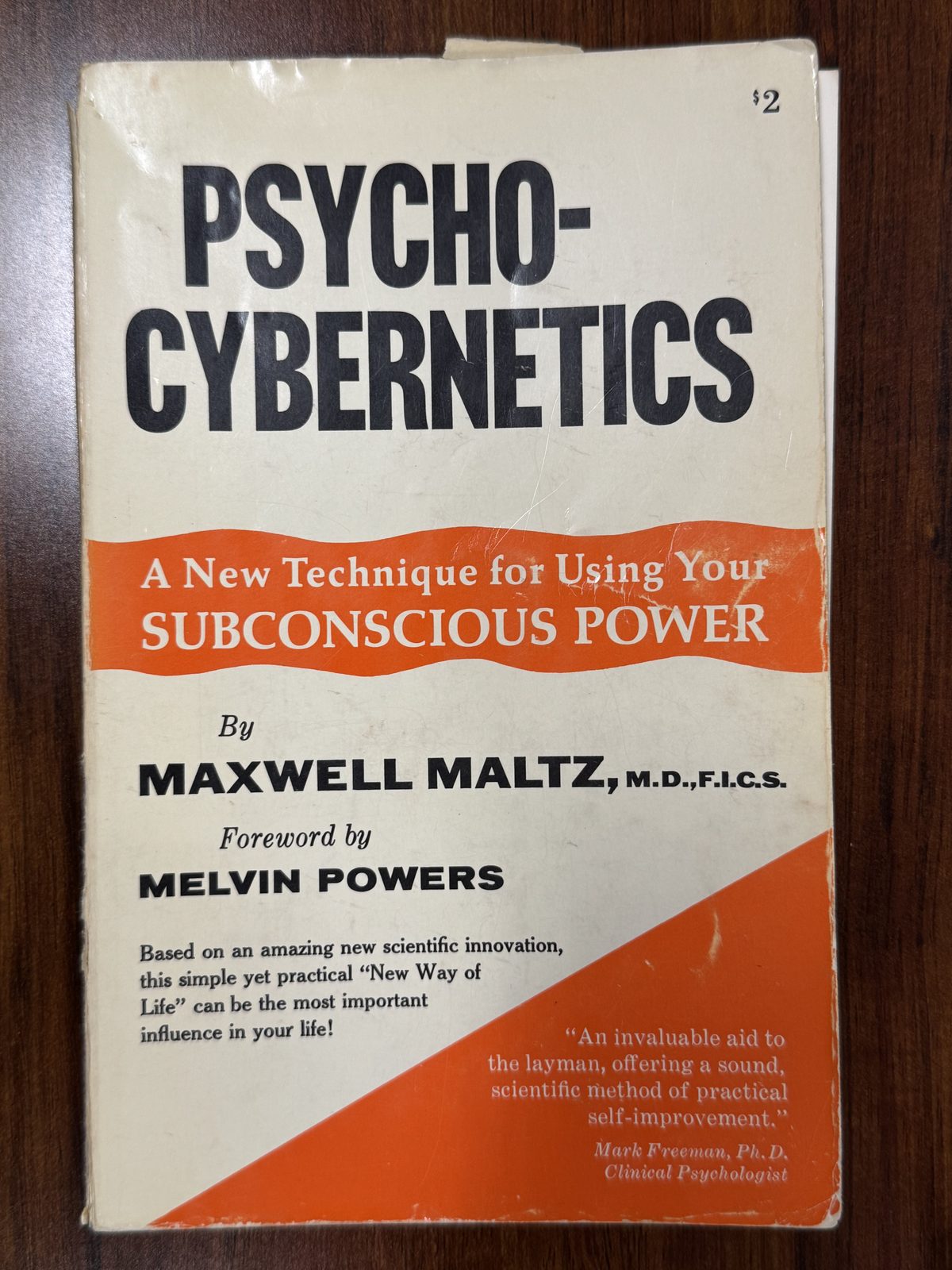
Sean Manion, a neuroscientist who has spent years in the archives of the early cyberneticians, looked at that shelf with us on No Way Out and gave it an honest grade. “Those would have been very much the first order cybernetic,” he said. “I feel like he only scratched the surface on the first order.” Then he added the part that matters. Boyd “was coming at all of this without the same background that they had, but finding the same conclusions.” Hold on to that. The shallow reading is what makes the rest of this story interesting.
What he called it
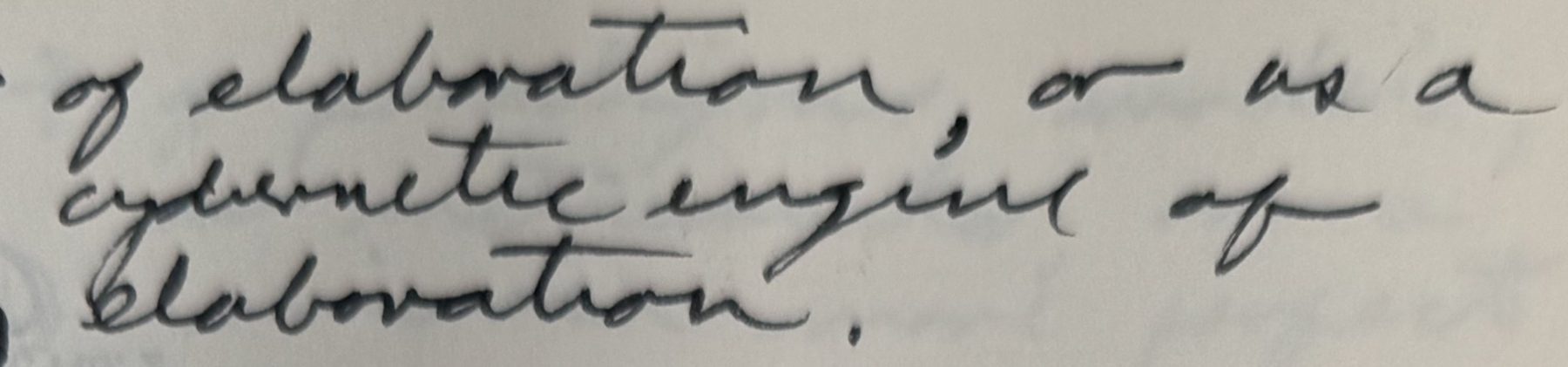
Few people have read Boyd’s marginalia. Osinga reports that Boyd gave his own theory several names in the margins of the books he read: a theory for intellectual evolution, a dialectic engine, and a cybernetic engine. I went to Quantico and photographed his copies of those books, and the names are there in Boyd’s own hand.
One of the earliest dated notes I found is in Jean Piaget’s Structuralism. Beside a boxed passage on Gödel, Boyd wrote, “Such statements reinforce my concept of Intellectual Evolution with its feedback mechanism,” and across the top of the page, “an open ended system that Gödel’s proof appears to support or reinforce.” He dated it 10/1/73. Feedback and an open system are already in the same breath, three years before the paper.

In his copy of Thomas Kuhn’s The Structure of Scientific Revolutions, the machine gets its name. On page 64 he asks, “Is not the Deductive/Inductive cybernetic process of change the engine for matching observed phenomena (for physical patterns) with [mental] models.” On page 171 he complains that Kuhn does not see how induction works “as a dialectic engine of elaboration, or as a cybernetic engine of elaboration.” Matching what you observe against the models in your head is the problem Destruction and Creation sets out to solve. Boyd called the solution a cybernetic engine.

Then there is page 143 of Michael Polanyi’s Knowing and Being. At the foot of the page Boyd names his idea the “Meta-Paradigm” and the “Dialectic Engine.” In the gutter beside the same passage he wrote “Cybernetic Engine” and drew a line straight through it.

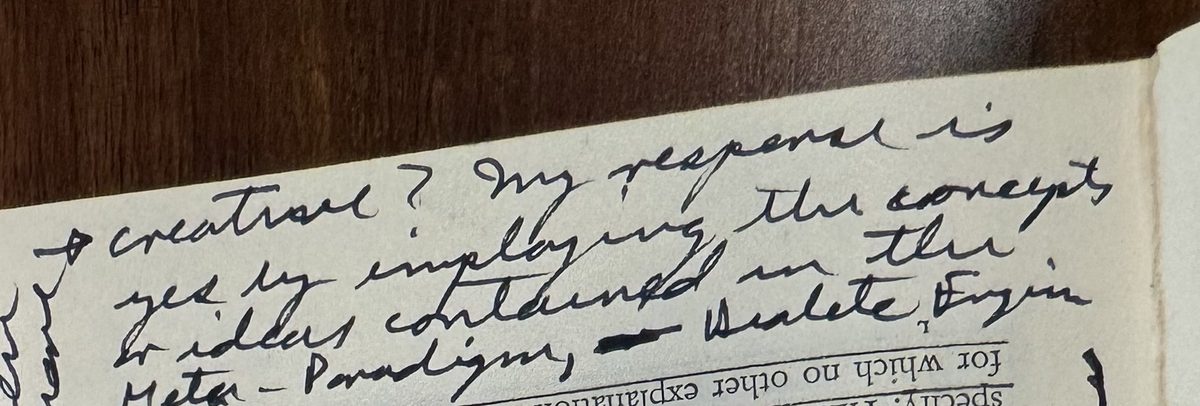
He did not retire the word. The Kuhn notes keep it, unstruck. But on that one page he made an edit, and he made the same edit again in his typescript.
The Boyd Collection holds the drafts of Destruction and Creation from February and March 1976. In those drafts, Boyd’s Dialectic Engine permits the construction of “feedback decision models.” By the 3 September 1976 version, the word feedback is gone, and the engine permits “decision models.” The rest of the sentence survived.
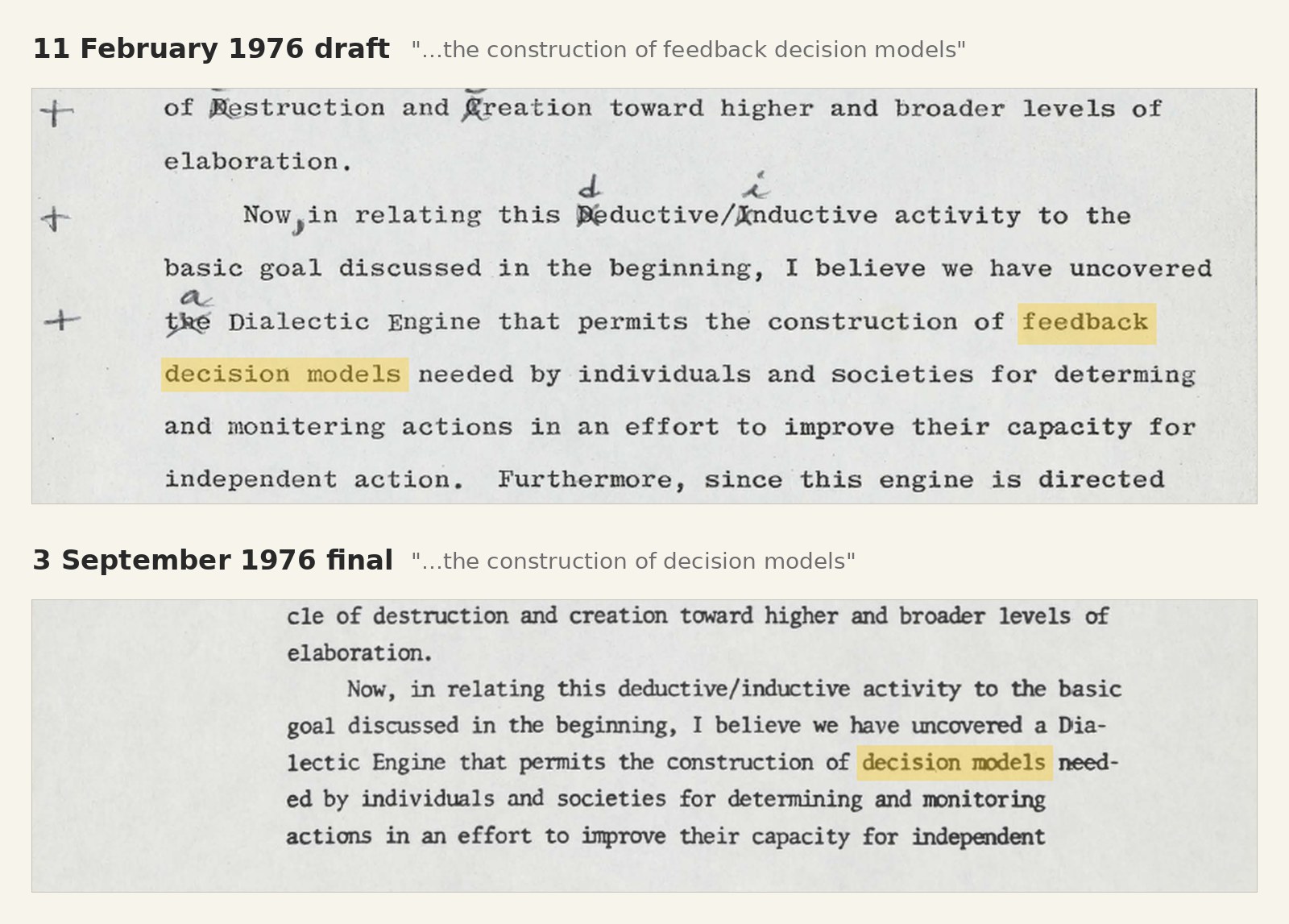
What stayed in is just as telling. The final paper still describes two sides of “a control mechanism.” Entropy drives one side. The goal of improving our capacity for independent action drives the other. Together they run the cycle of destruction and creation.
So why cut the word? Boyd left no note that says. I have a theory. Let me unpack it, and you can tell me where I’m wrong.
The machine he rewired
The way I understand it, classic cybernetics grew up around the thermostat. You set a number, the system measures the room, and it corrects the error back toward the number. The set point never moves.
Boyd read it that way too. In F. H. George’s Cybernetics, he bracketed the line that self-adapting systems become “goal-seeking, or purposive, seeking the goal of stability,” and wrote in the margin, “Trying to seek some equilibrium state.”

Boyd also read Ludwig von Bertalanffy, who argued that living systems are open systems. They trade matter, energy, and information with their environment, and the feedback loops of that era looked closed by comparison. Boyd took the point. Destruction and Creation says entropy must increase in any system that “cannot communicate in an ordered fashion” with the environment outside it. That is Wiener’s communication, carrying the load.
The same paper describes a system that tears down its own set point. When the match between concept and reality degrades, you shatter the concept and build a new one. A thermostat that rewrote its own number every time the house changed would stop being a thermostat. It would start behaving like something alive.
Boyd said what the thermostat was missing in the margin of Fred Hoyle’s The New Face of Science. Hoyle, he wrote, “even recognizes the feedback that takes place but he does not recognize the underlying mental activity working within the feedback loop.” The loop was fine. The mind inside it was what nobody had drawn.

Bobby Azarian, author of The Romance of Reality, drew the same line when he joined us on No Way Out. “Living systems to survive have to create a map or a model of the world around them,” he said. “And then to survive optimally, to live optimally, they have to make sure they’re updating that model of the world to be most consistent with actual reality.” A thermostat never updates its map. It only has the one number.
Boyd’s own answer is on the last page of his Kuhn. Kuhn describes science moving forward “without benefit of a set goal,” and Boyd underlined it. In the margin he wrote: “The Deductive/Inductive process is a self regulating process in which its existence, or equilibrium, […] is the elaboration of paradigms, models, […] instruments, or a universe more perfect than any before.” Put that next to his George note. In George, the system seeks an equilibrium state. In Kuhn, the equilibrium is the elaboration. The set point became the rebuilding. This is where Manion’s point lands. Without the cyberneticians’ background, Boyd was “finding the same conclusions,” and then he went a step past them. My guess is that “feedback decision models” sounded too much like the thermostat.

By 1995 the feedback arrows were back in the sketch. They run from Decision and from Action back to Observation. Implicit guidance and control runs out of Orientation straight to observation and action. Unfolding interaction with the environment closes the circuit. He drew no boundary around any of it. Ian Brown, in Snowmobiles and Grand Ideals, describes the sketch as a double-loop cybernetic model. That is the right name for it. The second loop is the part the thermostat is missing, the engine that rebuilds the model.
Why OODA loop cybernetics matters now
W. Ross Ashby’s law of requisite variety, which Osinga says Boyd adopted, and Roger Conant and Ashby’s good regulator theorem sit in the same lineage as Karl Friston’s free energy principle and active inference. Friston’s living systems persist by carrying a model of their world and acting to keep their sensations within bounds. Boyd was working the same problem in the 1970s, and his margin notes named the machine.
Friston said it plainly when he joined us on No Way Out: “You can regard a lot of the active inference formalism as basically a 21st century version of cybernetics as we had in the 1950s probably.” The man who built the free energy principle files his own work under Wiener’s heading. Boyd was already there in the 1970s, in the margin of somebody else’s book.
The fit has limits, and they deserve the same airtime. First-wave cybernetics kept the observer outside the system, reading the gauges. Boyd’s paper says the distinction between observer and observed begins to disappear, and it points to Laws of Form to make the case. He had already worried the point in his copy of Werner Heisenberg’s Physics and Philosophy: “How do we achieve this since the observer and observed cannot be distinguished from one another?” Under it he wrote, “part of same system.” That second-order move is where Boyd left the thermostat behind, and some presentations of the free energy principle still have work to do there.

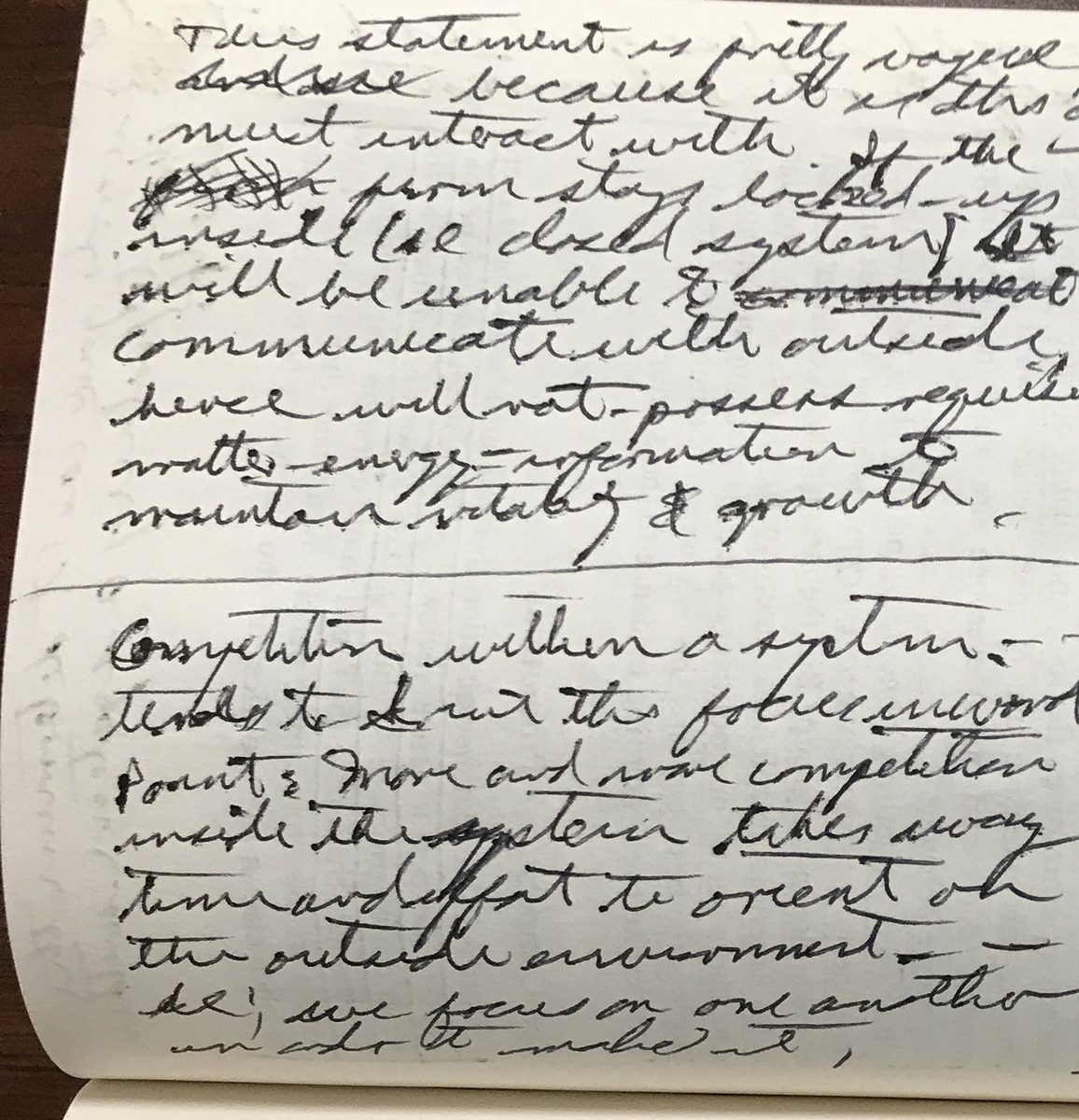
He never stopped applying it. In the early 1990s he was writing the same idea into the margins of business books. In Rafael Aguayo’s Dr. Deming he wrote that if a firm “stays locked-up inside (i.e. closed system) it will be unable to communicate with outside hence will not possess requisite matter-energy-information to maintain vitality & growth.” Below a ruled line he added the part every leader will recognize: “more and more competition inside the system takes away time and effort to orient on the outside environment.”
Back to the naming fight
Artificial intelligence, super intelligence, cybernetic control system. Boyd’s margins suggest the name matters less than the shape of the machine under it, and the machines are changing shape.
Most of the systems in the headlines learn from a huge, fixed body of data. Then the learning stops, the model gets frozen, and it ships. Inside a conversation it can adjust a little, but the model itself does not change, and when you close the window it goes back to what it was. That is a very sophisticated thermostat. The number on the dial was set before you typed a word.
The research Friston and Ramstead work on points somewhere else: agents that act on the world, take in what comes back, and revise their model while they work. That is Wiener’s control and communication, running in both directions. It is also the loop Boyd drew in 1995, with Orientation at the center, implicit guidance and control running out of it, feedback running from Decision and Action back to Observation, and an environment that keeps unfolding whether the model is ready or not. Whatever Washington calls these machines, the ones that matter will have to stay coupled to the world outside them.
The same test applies to people. If you lead a team, run a trading desk, or own the strategy, watch how your organization corrects. A team that only corrects back toward the plan is running a thermostat. To thrive, you need an adaptive approach that reads a shifting environment. Any talk of a high-definition destination or a clear end state is a fool’s errand. Can your people tell when the plan itself is the error, and can they rebuild it before the market or the opponent does it for them?
Sources
Photos show the covers of Boyd’s copies and cropped details of his handwriting, shown for commentary. The printed pages are not reproduced.
John R. Boyd Collection, COLL/2062, Marine Corps History Division, Quantico, VA: “Draft, Destruction and Creation,” 11 February 1976 (Box 3, Folder 5); “Destruction and Creation,” 12 March 1976 (Box 3, Folder 6); “Destruction and Creation,” 3 September 1976 (Box 4).
John R. Boyd Papers, Series 1 (Books), Marine Corps History Division, Boyd marginalia. Photographs by Brian “Ponch” Rivera, 9 December 2019 and 8 June 2026: Maxwell Maltz, Psycho-Cybernetics (1971), foreword by Melvin Powers, p. IX; F. H. George, Cybernetics (1971), p. 12; Jean Piaget, Structuralism (1971), p. 34, note dated 10/1/73; Thomas S. Kuhn, The Structure of Scientific Revolutions, 2nd ed. (1970), pp. 64, 171, 173; Michael Polanyi, Knowing and Being (1969), p. 143; Fred Hoyle, The New Face of Science (1971), p. 5; Werner Heisenberg, Physics and Philosophy (1962), p. 144; Rafael Aguayo, Dr. Deming (1991), p. 198.
John R. Boyd: A Register of His Papers, Marine Corps History Division, 2020, Boxes 28 and 29.
John R. Boyd, “Destruction and Creation” and “The Essence of Winning and Losing,” in Grant T. Hammond, ed., A Discourse on Winning and Losing, Air University Press, pp. 315 to 325 and 384.
Frans P. B. Osinga, Science, Strategy and War: The Strategic Theory of John Boyd, Routledge, 2007, pp. 56 and 72 to 75, notes 20 and 103 to chapter 3.
Ian T. Brown, Snowmobiles and Grand Ideals, Marine Corps University Press, p. 49.
Norbert Wiener, Cybernetics: Or Control and Communication in the Animal and the Machine, MIT Press, 1948.
Sean Manion, No Way Out, Ep 98, “The AI Edge: Why OODA, Cybernetics, and Neuroscience Matter,” January 27, 2025. Watch on YouTube.
Bobby Azarian, No Way Out, Ep 36, “The Reality of Boyd’s Loop: Neuroscience, Complexity and Flow,” August 8, 2023. Watch on YouTube.
Karl Friston, No Way Out, Ep 164, “Karl Friston Decodes the Real OODA Loop: Active Inference and What Boyd Got Right,” April 28, 2026. Watch on YouTube.
“Trump says he’s renaming AI ‘super intelligence’,” The Washington Post, September 22, 2026. Link.
“Trump renames AI ‘super intelligence’ as leaders jostle over dangers,” The Standard, September 22, 2026. Link.
Maxwell Ramstead (@mjdramstead), post on X, September 24, 2026. Link.