

AGLX has been working with the Guardians for over 10 years. We weren’t brought in to solve a problem or work on a project, we have been providing specialist services to an organisation that has been consistently striving to live their purpose by taking advantage of their endowments.
The Guardians Context
Purpose:
Kia toitū te haumi hei hua mā ngā tāngata katoa o Aotearoa
Sustainable investment delivering strong returns for all New Zealanders
AGLX facilitated the process that led to the purpose statement and principles for the Guardians.
The Guardians of New Zealand Super Fund has some investment advantages that are consistent with the complex system that they are in. They refer to these as their endowments[1].
1. Long term horizon – we have the ability to invest in illiquid assets and to ride out short-term market movements
A long term view means that the Guardians are not focused on satisfying the needs of short term investors. This often forces organisations to develop strategies to achieve short term gains. In complex systems prediction is risky because it cannot account for emergent behaviour.
2. Operational independence – Fund investments are made on a purely commercial basis.
Politicians and pundits love to play the role of experts and provide their advice. At AGLX we refer to these people as ‘good idea fairies’[2]. Non linearity means every ‘good idea’ will have many unintended consequences. Good ideas are often just repackaged biases.
3. Sovereign status – this allows us to pay lower tax in some jurisdictions and is often favourably regarded by business partners.
Not really a complexity friendly idea, but nice to have 🙂
4. Governance – The Guardians is designed to operate at arms’ length from government
Complex Adaptive Systems cannot be controlled from a centralised point. For adaptation to be effective, the interactions need to be self-directed. For complex adaptive systems to survive in a non-linear system that is far from equilibrium they need a clear feedback signal. Any political interference will distort the relative strength of this signal and will inevitably lead to failure.
[1] https://nzsuperfund.nz/how-we-invest/endowments/
[2] https://www.aglx.com/aglx-thinking/santas-ice-innovation/
A TPA before TPA was a thing
Rather than focusing on performance as a set of independent asset classes, the Guardians view performance as a total return on all investment activity. They shifted their approach to diversification to focusing on portfolio risk instead of specific assets. The investment committee led by the CIO took on much of the responsibility for decision-making. The board were there to govern, not lead. The most significant shift was the clear desire to be ‘one team’, not a set of competing investment groups.
In funds management, this adaptive approach has since been called the ‘Total Portfolio Approach’. TPA has come to be recognised as the new paradigm in governance and organisational development for wealth funds. As with many emergent ideas, some are now busy categorising, defining and reducing TPA to its parts (governance, people, investment) so they can reconstruct it in other funds. You could call this ‘adaptive funds management’, which is entirely consistent with the principles of adaptive strategy.
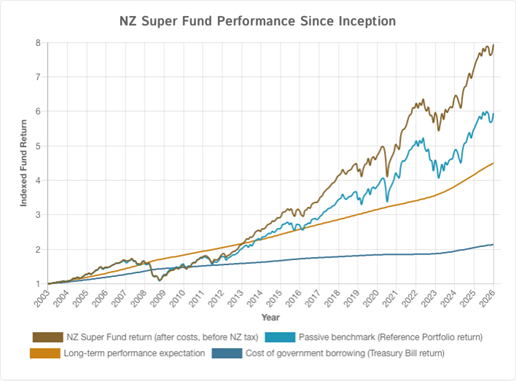
The Guardians of New Zealand Super have consistently outperformed most other sovereign wealth funds for more than a decade. They consistently beat their benchmark and long-term expectations. Along the way the Guardians have set the benchmark for ethical and sustainable investment. The Guardians have shown that sticking to a clear set of principles and taking a long-term view is a sound strategy for long term success.
What was the challenge that lead to engaging AGLX?
The Guardians weren’t looking for a consultant to fix a specific problem. Instead, their challenge was how to continue to adapt and thrive in the complex, non-linear global investment system while staying true to their endowments and purpose. The Guardians needed to set a clear direction of travel, strengthen their ability to adapt, govern at arm’s length, and maintain coherence as one team.
What did AGLX do?
We provided organisational development structure to the emerging TPA approach and advised on strategy development. We articulated the ‘way of working’ and introduced the process for rapid experimentation.
At the Guardians, what is now called the TPA, emerged organically as they worked toward a shared objective. It was not directly imposed by management nor part of some grand ‘transformation process’ designed by a consultant. We supported the organic change by facilitating a strategy that amplified the positive aspects of this new way of working and used constraints to continue to focus energy on the adaptive process. This was a process of sustained intervention shifting toward the things that were consistent with the TPA and away from the things that weren’t.
Individual Training and Development – Leading in Complexity.
Education and training for investment professionals is similar across most universities and business schools. Despite an increasing acknowledgement of the complexity of the global investment market, there are almost no university level courses and training designed to help people understand complexity and how to make decisions under conditions of uncertainty. AGLX have provided specialist training for leaders and teams at the Guardians to introduce them to complexity and teach tools and techniques that allow them to navigate complexity to create strategic advantage. We continue to provide access to specialist seminars and workshops for Guardians Staff.
Team Development – Uncovering Principles
We wanted to show the organisation how the principles of teamwork, supportive culture, ethical investing, and focus on long-term performance contributed to its success. We used a set of techniques called ‘naturalised sensemaking’ to gather anecdotes and stories about the team’s experience in the organisation, both good and bad. It enabled leaders to see where they could focus on getting ‘more stories like these’ (positive experiences) and ‘fewer stories like those’ (negative experiences). We used the themes from this process to articulate the organisation’s principles and derive the purpose statement described above. This process allows for the emergence of meaningful principles instead of the artificial principles that most consultant-led workshops create. These end up as platitudes – nice statements that no one can disagree with but don’t really add value to decision making.
An example of the emergence of principles through story telling was found in a set of stories concerning an investment that went bad. Many people in the investment team had to come into the office on Christmas day to help sort out the issue and prevent further losses. On the surface, this looked like a very negative situation, and you might expect the staff concerned to be angry about the bad investment decision and having to miss part of their family Christmas. Surprisingly, many staff signified this as a very positive story. It showed that regardless of the circumstances, they knew that their colleagues would have their back. No one was blaming anyone, and they were united in mitigating the loss and moving on.
Adaptive Strategy – The scaffolding for a TPA
A total portfolio approach is dependent on the dynamic allocation of resources across a diverse set of assets. The portfolio can adapt to change. The team that operates this model should themselves operate in an adaptive way. Adaptation at a strategic level required three things:
- A shared understanding of success. Direction and Main Effort
- A shared operating and decision-making models
- A ‘model of operation’ that provides early detection of weak signals, rapid response to those signals and exploitation of new sources of value.
The AGLX Adaptive Strategy process has been developed to help organisations turn complexity into a strategic advantage.
AGLX facilitated the development of an adaptive strategy for the Guardians team. One risk with a shift of this magnitude is that the effort will dissipate over time, and those constrained by the conventional approach will ‘revert to type’. To mitigate this, we supported the organisation by mapping constraints and discussing how much effort we would need to shift the constraints that inhibited the adaptive strategy and reinforce those that supported it. We advised leaders on adaptive leadership and supported them in facilitating experimentation.
Prioritisation
AGLX has developed an approach to workload prioritisation that provides a visual representation of the workload and the mechanism for prioritising workflow over time. Our model is specifically designed for organisations with multiple competing priorities and a changing strategic landscape.
Prioritisation within a system with limited resources can shift the organisation back into a defensive mode, each team competing to defend their budget and gain an advantage over other teams. Prioritisation is seen as a zero sum game. Our mapping process is designed to provide a shared understanding of the time and energy spent on each project. This allows for a collaborative and productive discussion on how to shift the time and energy. Prioritisation becomes a process of ensuring the whole is greater than the sum of the parts.
What has been the result?
Over a decade of collaboration, the Guardians of New Zealand Super Fund has developed the capability to thrive in complexity by growing the conditions for adaptation at every level of the organisation.
Through individual training and team development, the Guardians built a shared language and set of principles. The ‘one team’ culture that emerged through naturalised sensemaking strengthened trust across the organisation, creating a strong foundation for collective decision-making.
The adaptive strategy process gives the Guardians a durable scaffolding for strategic decision-making. They now operate with a clear direction, a shared model of operation, and the ability to detect and respond to weak signals early. This approach underpinned the successful shift to the Total Portfolio Approach (TPA), now widely regarded as a benchmark in sovereign wealth fund governance.
Prioritisation practices help the organisation manage competing demands without falling into internal competition. By visualising energy and effort across the system, the Guardians created the conditions for collaborative trade-offs.
Together, these outcomes reflect not a one-off transformation, but the sustained development of adaptive capacity. The Guardians continue to outperform peers, not just through financial returns, but by maintaining their purpose, ethical standards, and long-term approach in an increasingly complex global investment environment.
The Guardian's Perspective
“A lot of the things about adaptive strategy and the way Steve describes it just felt very intuitive to me, you can’t predict the future, you can’t map out a linear path to get where you want to be because there are so many things impacting it along the way.
We’d previously done work with Steve and the AGLX team when our board and executive team revisited and refreshed our purpose and vision, so they made sense as partners — they knew us, they knew our idiosyncrasies and the very intellectual way of thinking our people apply. They were natural partners to work with us as we started on this journey.
Right from the start we engaged our board, that was really important. We did a lot of ongoing and iterative education sessions with them, and having Steve come and take them through the theory meant they could ask questions and really get their head around it. That made it easier for us as management to say, ‘this is how it applies in our world. We also brought our people into it really early. For this to be successful, they had to buy into it, understand it, and feel empowered to work within it. We’ve now got our strategy, Guardians of the Future, based on adaptive strategy principles. We’re moving into activation now — doing things differently, setting those positive constraints so not every clever idea gets done, and helping our people understand and work with that”
– Paula Steed, Chief Operating Officer
Hear more from Paula Steed as she shares the Guardians’ journey of co-developing an adaptive strategy with AGLX in the webinar Adaptive Strategy – The Changing Paradigm on Management Thinking.
Watch the full webinar here..
Wealth Funds as Complex Adaptive Systems
Complex adaptive systems theory is the framework that underpins the TPA.
The global investment market has all the characteristics of a complex adaptive system (CAS), namely:
1. It consists of many elements that themselves might be simple (or complex)
2. These elements interact dynamically by exchanging energy or information
3. Interactions are non-linear – small changes can have big consequences
4. There are many direct and indirect feedback loops
5. There are systems within systems – energy exchange occurs at many levels concurrently
6. They have a collective memory; it is not stored or controlled from any one point (sorry Bloomberg)
The rich, dynamic, fed back non-linear nature of the global investment market means that it operates at conditions that are far from equilibrium. This leads to a condition called ‘emergence’ – system level behaviour that cannot be predicted from inspection or analysis of the components. (a feature that seems to escape most analysists)[1]
Above all, complex systems are adaptive. They can reorganise and change based on feedback without the intervention of an external agent. (why most central bank policy is but wishful thinking)
Sovereign Wealth Funds are a complex adaptive subsystem of the complex adaptive global investment system. AGLX are specialists in Complex Adaptive Systems Theory. Our consulting practices are built around authentic approaches to complexity.
[1] https://www.goodreads.com/book/show/665134.The_Mis_Behavior_of_Markets Mandelbrots excellent book on fractal market behaviour should be compulsory reading for anyone who is engaged in market analysis or forecasting.