

Why AI keeps teaching the four-step, linear OODA loop, and how the error feeds itself
Some of you might see the irony in what I’m about to share. If you’ve been following the conversations on cognitive outsourcing, including ours on the No Way Out podcast, this one’s for you.
Ask an AI to explain the OODA loop, and it will almost always hand you the same answer: the four-step, linear OODA loop. Observe, orient, decide, act, and cycle faster than the other guy. That version is everywhere, from staff college slides and strategy decks to airport business books, and now it sits in the training data of large language models. It is also a different loop from the one John Boyd finally put on paper.
That gap matters to anyone using AI to brief a board, pressure-test a strategy, or think out loud with a model. When you do that, you hand the machine part of your orientation, the mental model that decides what counts as a fact, a threat, or an opportunity. Boyd called orientation the Schwerpunkt, the focal point, because it shapes the way we observe, the way we decide, and the way we act. It is the last thing a leader should outsource, and the answer you get back has already passed through the biases and filters of the closed system you handed your thinking to.
Frequency over fidelity
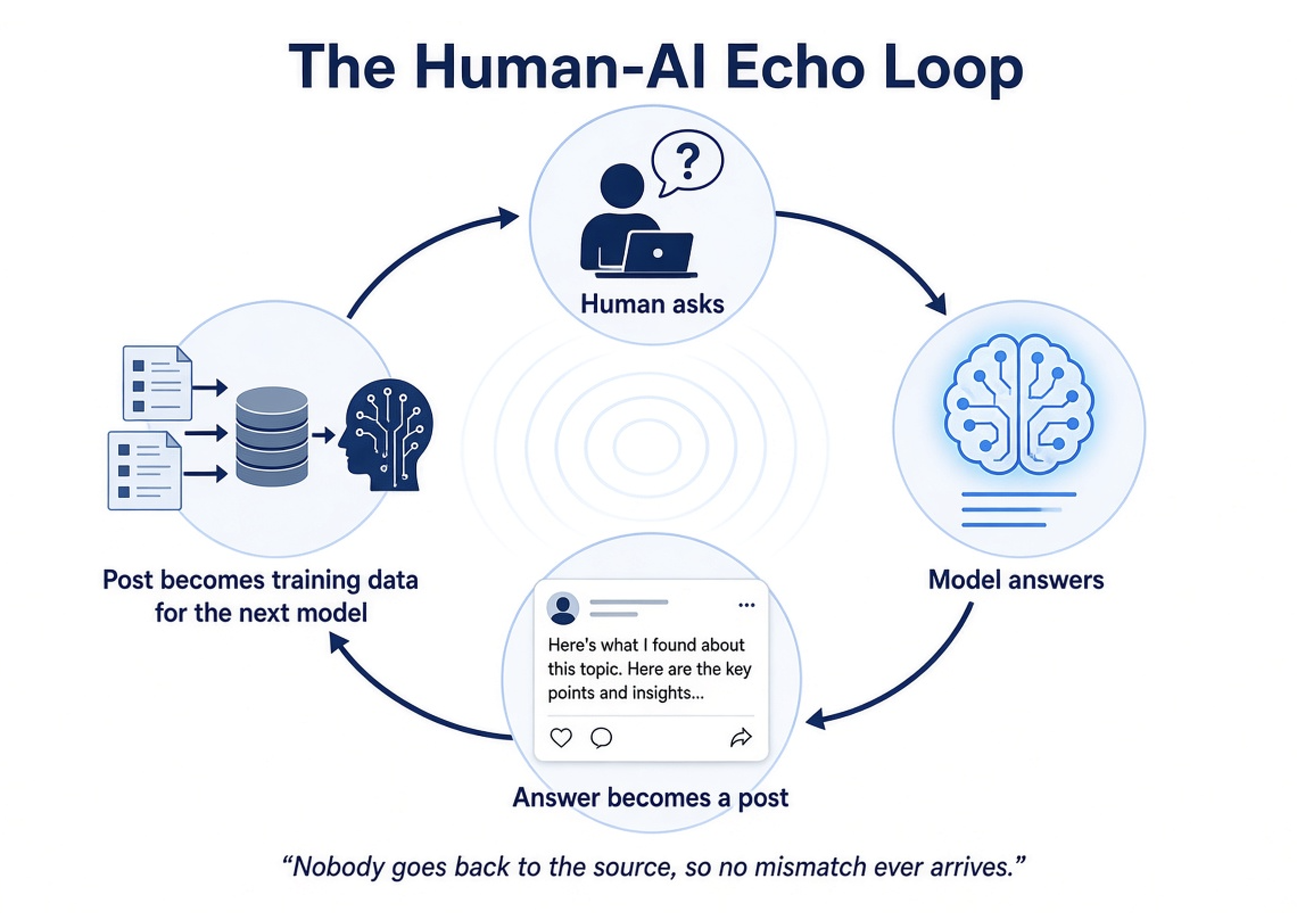
Large language models favor repetition over provenance. They count how often a claim shows up, and they never ask where it came from. The four-step cycle has been copied for decades. Boyd’s actual sketch showed up late, in The Essence of Winning and Losing, a June 1995 briefing, two years before he died. One late briefing can’t outvote a generation of simplified slides.
So the model does what models do. Its answer slides into the deepest groove, like a sled on a well-worn run. People paste that answer into posts, decks, and blogs, the next model trains on the output, and the wrong picture gets louder. The machines borrowed the wrong model, the same way military officers were indoctrinated into it.
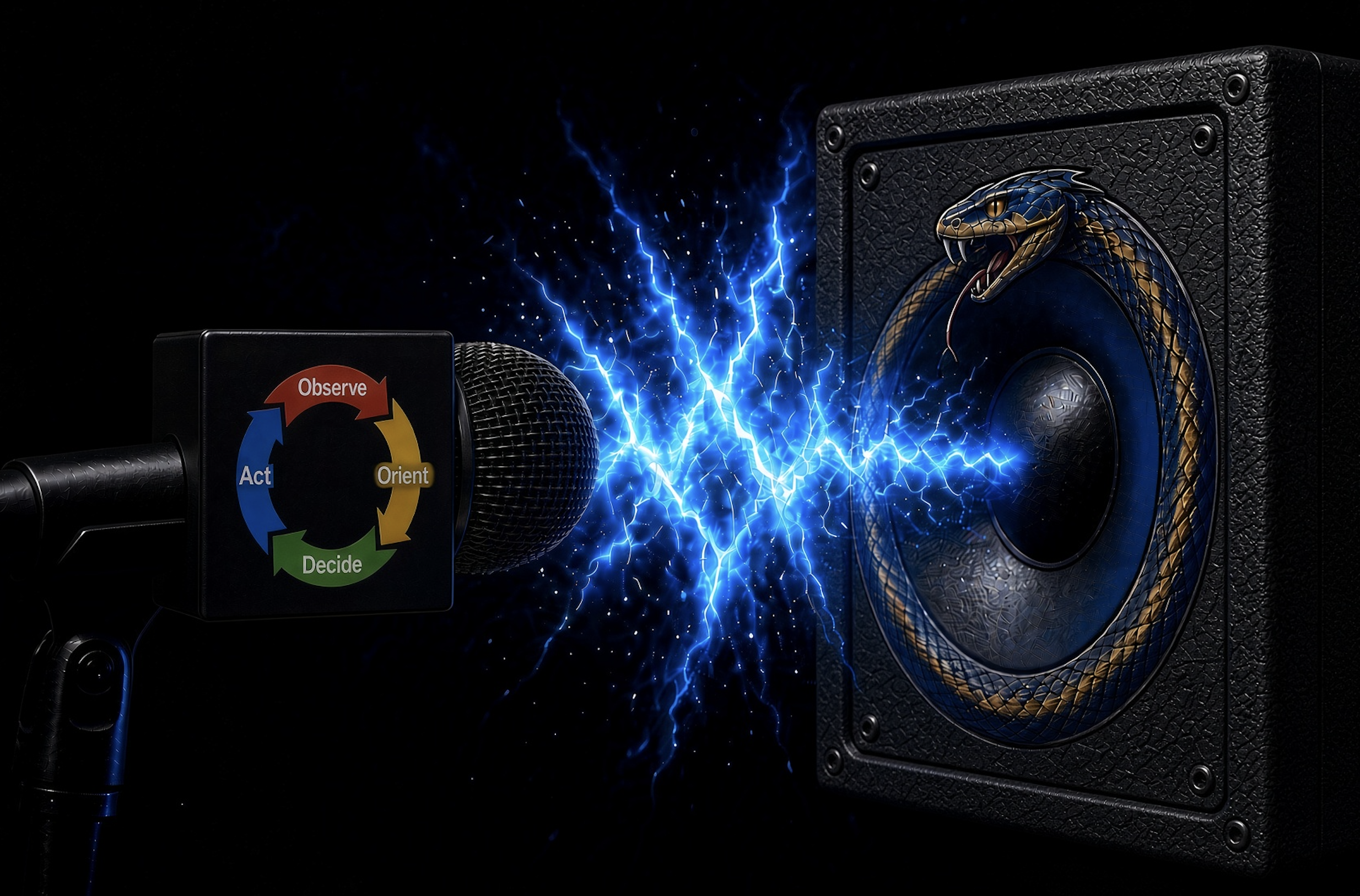
Chuck Spinney and the group working with Boyd had a name for this. They called it incestuous amplification: the preconceptions in your orientation misshape the observations that feed that same orientation. Picture a microphone held up to its own speaker. The sound goes out, comes back in, gets louder, and pretty soon the only thing in the room is the squeal. Left uncorrected, Spinney warned, incestuous amplification “always tears any decision cycle to pieces from within.”
Here’s the kicker. The four-step cycle has no arrow from orientation back to observation, so it can’t even draw this failure. The model AI keeps teaching is blind to the problem AI is helping create.
The loop Boyd drew
In “Organic Design for Command and Control,” Boyd defined orientation as “an interactive process of many-sided implicit cross-referencing projections, empathies, correlations, and rejections that is shaped by and shapes the interplay of genetic heritage, cultural tradition, previous experiences, and unfolding circumstances.” Think of it as a workshop that never closes, where you imagine, compare, discard, and rebuild. The four-step cycle treats it as a coffee filter that data drips through on its way to a decision.
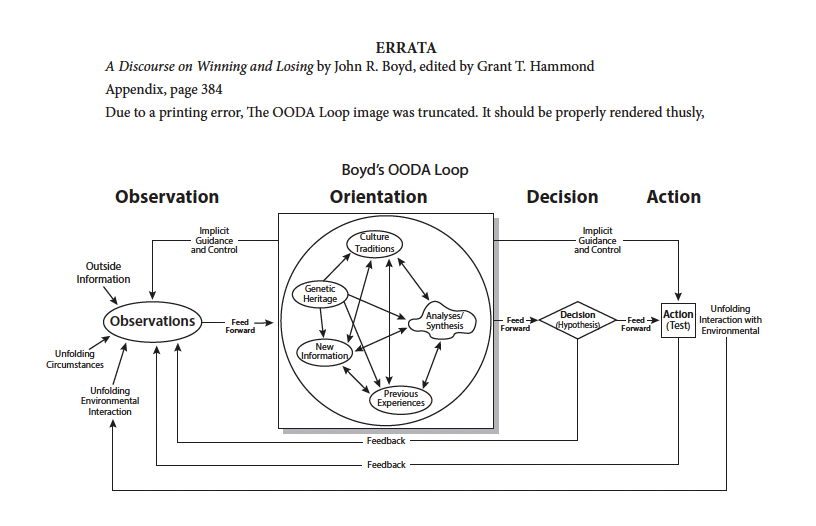
His 1995 sketch makes the same point in pictures. Decision is labeled “hypothesis.” Action is labeled “test.” Feedback runs through the whole system, including an implicit guidance and control path from orientation straight to observation. Then Boyd went one step further and noted that “the entire ‘loop’ (not just orientation) is an ongoing many-sided implicit cross-referencing process of projection, empathy, correlation, and rejection.”
The simulation space some people now want to add to the OODA loop, the scenarios, counterfactuals, and R&D, was already in Boyd’s drawing. The four-step cycle stripped it out, and AI, trained on the four-step cycle, treats the stripped-down version as the truth.
Why the machine calls the wrong idea brilliant
A recent LinkedIn exchange showed the mechanism in miniature. Graham Beresford, who is exploring the connections between cybernetics, predictive processing, the Free Energy Principle, and Boyd, asked an AI about replacing “Orient” with “Envision.” The model called the change “brilliant” and said it turned orientation into “an active, stochastic simulation space… rather than just passive data filtering.”
I like Graham’s curiosity. He is doing the work I wish more authors of recent OODA books had done: digging into the ideas behind the loop and chasing down the primary sources. The praise is the tell. The AI graded “Envision” against the four-step cycle, the version it has seen most. Against that baseline, “Envision” looks like an upgrade. Against Boyd’s sketch, it is a demotion, because it takes a process Boyd spread across the whole loop and pins it to one box and one verb.
Models tuned on human feedback also learn that people enjoy hearing their idea is brilliant. Read that flattery as a product feature, and keep your quality checks somewhere else. Agreement is exactly what feeds the squeal.
Why this matters in the boardroom
Leaders are already building this loop at scale. A team asks the model for an industry frame, and the model returns the most common frame. The team drops it into the strategy memo. The memo becomes next year’s training data, internal language, and vendor pitch. Competitors using the same tools converge on the same map. Differentiation dies quietly, and nobody notices, because the machine keeps calling the map insightful.
The same pattern shows up in product reviews, competitive intelligence, risk registers, and AI-assisted scenario planning. Treat orientation as a filter, and the organization gets faster at acting on a picture that has lost contact with the world. Speed turns into a liability.
Boyd’s warning was to keep your picture of the world provisional, test it, and rebuild it when reality disagrees. An active inference agent has that drive built in. Its own math puts a value on information that resolves uncertainty, so a conflicting source registers as a surprise it has to explain. An LLM has no such drive. It never runs an action as a test, so nothing it believes is forced to collide with the world. A serious user of these tools has to supply the collision.
What to do instead
Keep the models, and change how much they get to shape your orientation. Four habits help.
- Separate drafting from orientation. Use AI to summarize, stress-test language, or generate options. Get your first explanation of the concept that will govern the decision from somewhere else. If the model is teaching you the frame, it is already inside your loop.
- Force a source check when the stakes are high. When two accounts conflict, and on the OODA loop they do, go to the primary text. Boyd’s A Discourse on Winning and Losing is free from Air University Press. Ian T. Brown and Frans P. B. Osinga’s Snowmobiles and Grand Ideals, free from Marine Corps University Press, has transcripts of the recorded briefings, the closest most of us will get to hearing Boyd work through orientation himself. Primary sources surprise you, and that surprise is the mismatch that updates your orientation.
- Treat praise as a warning light. When the system blesses a reframing on the spot, ask what baseline it used. “Brilliant compared with the four-step cycle” and “true” are two different grades. Then ask what would falsify the idea, and what Boyd’s sketch, the market, or the customer would do to it.
- Keep a human loop that can see its own distortion. Your organization needs the arrow the four-step cycle leaves out. After-action reviews, red teams, customer contact, and dissenting staff all exist to break the microphone-and-speaker circuit. If AI makes internal agreement cheaper, you need more outside friction.
The irony runs deep. People ask machines to explain a loop whose central warning is to keep your orientation out of a closed system. The machine, trained on the most repeated version of that loop, hands back what Boyd called a fixed recipe: disconnected from the environment, but connected to some formality.
So before you outsource the part of your thinking that tells you what you’re seeing, go to the source. The model can’t do that for you. That’s still the leader’s job.
Brian “Ponch” Rivera is the co-founder and CEO of AGLX Consulting and co-host of the No Way Out podcast.