

The Necessity of Adaptive Strategy in a Complex World
Being strategically adaptable is not a luxury—it is a requirement.
Every company, regardless of size or industry, must decide how to handle an uncertain future in order to succeed. Since no one can predict every twist and turn, businesses must develop the capacity to adapt.
However, many organisations struggle to integrate adaptability into their strategy development and execution. They fail to effectively manage what they can control within their environment to achieve success.
The Common Objections to Building the Capacity to Adapt
A frequent objection to adaptive strategy is, “We’re not mature enough to adopt that way of doing things” or “We’re not ready to do something new until we’ve implemented XYZ.”
This thinking assumes a linear progression—this, then that. Organisations believe they must first reach a specific level of stability or process maturity or implement a new technology platform before considering the practices necessary to build the capacity to adapt. This thinking is flawed. In reality, success is not about reaching a perfect future state before taking action. Instead, it is about continuously adapting in response to change. How much of this and that.
Worse, businesses that prioritise process maturity over adaptability may reinforce rigidity, making it harder to respond effectively to unforeseen changes. They end up developing the wrong muscle—one that locks them into outdated practices rather than preparing them to thrive in uncertainty.
The Landline Analogy: Learning from Kenya’s Telecommunications Evolution

The evolution of telecommunications in Kenya is a useful analogy. In 1990, only 0.74% of the population had landline connections. This figure peaked at just 1.62% in 2009 before plummeting to 0.12% by 2023. In contrast, mobile phone adoption skyrocketed from 2% in 2001 to 121% by 2023.
Imagine if Kenya (by no means the only country where this has occurred) had insisted on providing everyone with a landline before investing in mobile infrastructure. It would have been a costly and ultimately pointless exercise, given that mobile phones were clearly better suited to the environment. The decision to bypass extensive landline adoption and invest directly in mobile technology allowed Kenya to leapfrog outdated systems and embrace a more effective and appropriate solution.
This is the same principle behind adaptive strategy. It acknowledges that the environment is complex and constantly changing. It is the appropriate choice for any business facing uncertainty and change. Rather than investing in rigid processes, businesses should develop the capacity to sense and respond to change dynamically.
Adaptive Strategy: The Right Move for Your Business
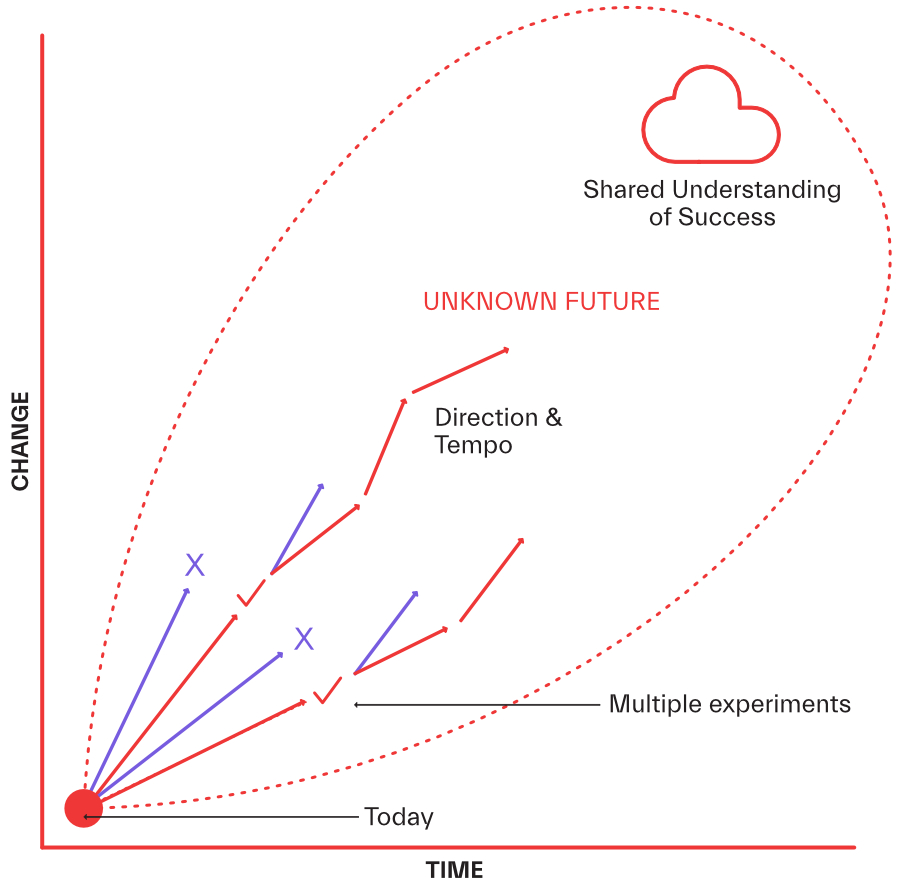
Developing an adaptive strategy does not require a complete overhaul of your business overnight. You can start today. It begins with a shift in thinking—from seeing strategy as a fixed plan to viewing it as a continuous process of learning (analysis and experimentation) and adjusting.
As my colleague Steven McCrone says “Strategy in practice is nothing much more than a continuous, coherent management of constraints to achieve success.”
This approach enables businesses to remain flexible, seize emerging opportunities, and navigate unexpected disruptions effectively. It also establishes a shared understanding of success, ensuring that everyone in the organisation is heading in the same general direction and can make decisions together with confidence.
At AGLX, we help businesses (case studies here) achieve exactly this. Our approach to adaptive strategy development and activation ensures that your organisation is both clear on its direction and effective in making decisions together. This means building the necessary capacity to respond to change, not as a reactionary measure, but as an embedded capability.
The Bottom Line: Skip the Landline Phase
Your customers and community are not waiting for you to reach an ideal level of maturity before you begin developing adaptive capacity. You don’t have to use a landline before you can use a mobile phone.
In a complex and rapidly changing environment, adaptability is not optional—it is essential. Organisations that embrace adaptive strategy now will be the resilient ones that thrive in the future.