

Embrace the opportunity, don’t fear the future.
This article is a rebuttal to the doom sayers, and hand waving experts predicting your AI initiated demise. Spoiler alert: It won’t (unless you let it).
I’ll use three arguments to make the point: logic, systems theory and evidence.
1. Logic: The one factor myth
The one factor myth is the false assumption that technology is the only thing changing and everything else will stay the same. It is an easy logic trap to fall into when a new technology like AI suddenly dominates our thinking.
The pattern is usually the same:
- A new technology arrives
- It is adopted within a well-established socio-technical system (your organisation / business environment)
- The system has a degree of inertia, so the new technology is mostly used to make existing processes more efficient or faster
- ‘Experts’ extrapolate this efficiency and speed to the nth degree and predict that a lot of people will soon become redundant
This seldom happens for two reasons:
- New technology changes the landscape of opportunity and provides the context for new ideas, value creation and ways of working
- People are smart and adaptive – they will learn the skills and deploy them within the emerging reality
The one factor myth misses the point that people, organisations and technology are entangled. If you change one thing, the others will also change and adapt. There will be unintended consequences and second order effects. The ability to predict the way in which AI will affect a single business or the sector is very low. Beware of ‘experts’, they are often trapped in a narrow world view.
2. Systems Theory – The Adjacent Possible (TAP)
In the 1990’s a US complex systems researcher Stuart Kauffman, formalised a theory that most people intuitively feel. The rate of change is accelerating. In its simplest terms it states:
“what can come to be in any given context is only that which is one step away from what currently is”.
In colloquial terms, it means that combining existing things creates new things. Once an adjacent possible thing is actualised, it enables the discovery of more new things that may be actualised. So if we start with a small number of ‘things’ then the pace of change is predictably slow. In the Lower to Middle Palaeolithic period the shift from crude stone axes to more sophisticated stone scrapers and knives took almost 1.5 million years. It only took another 150,000 years for these scrapers to become needles and spear tips. For our distant ancestors, change was so slow as to be safely ignored.
Compare this to the rate of change that we see today. In terms of your life, work, and leisure activity, what has changed in the last 100 years? The last ten years? 12 months?
As more things are recombined, they create a broader range of adjacently possible new things. For example, nothing ‘caused’ the iPhone to be created. The independent invention and utilisation of technology such as phones, mobile networks, digital platforms, digital cameras, touch screens etc created the space in which the iPhone was adjacently possible. They didn’t create the iPhone they enabled it. Until the space was available the iPhone wasn’t possible.
Just because something is possible, it does not mean that it will become reality. The wheel was invented sometime around 4,000 BC in Lower Mesopotamia. Chests (as in a box for storage) were invented no more than a millennium later. Yet it was not until 1970 that Bernard Sadow came up with the idea to put wheels on chests. The adjacent possible had existed for roughly 5,000 years before the context was right. The invention of air travel was not necessary for the invention of wheeled luggage, but it was necessary to provide the space for which this invention was useful.
This means that our ability to predict the things that will become possible and emerge from the strategic landscape is very limited.
The TAP formula is below. It looks intimidating but is easy to understand:

The graph of the TAP formula is also easy to understand.
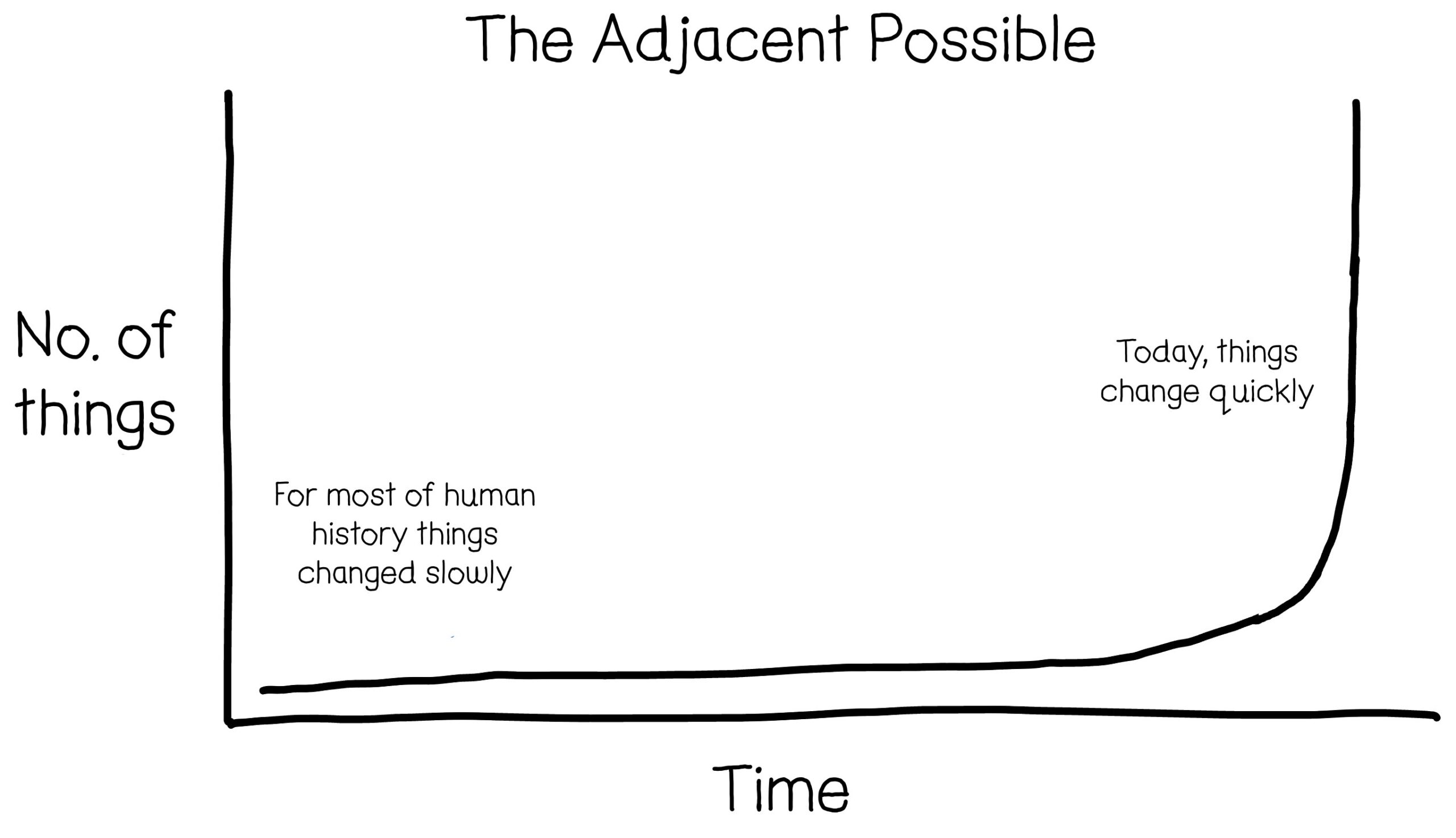
In summary:
- After a slow start the rate of change accelerates at an alarming rate
- For most of human evolution change was very slow, the future was mostly predictable
- Today, change is fast and the future is mostly unpredictable, but…
- We are prone to believing we can predict the future through analysis of the present and are vulnerable to logical fallacies like the one factor myth and experts who claim some insight that is unavailable to us.
AI doesn’t change the shape of the curve; it is part of the curve. So, for those hand waving experts who are predicting the end of days, what does this mean?
3. Evidence: Historic Example
The lived experience of those facing technology disruption in the past provides some evidence of how AI will impact our business. I’ll illustrate this point with the following newspaper article from the Daily Mirror in 1954. This example shows the one factor fallacy and ignores the adjacent possibles.
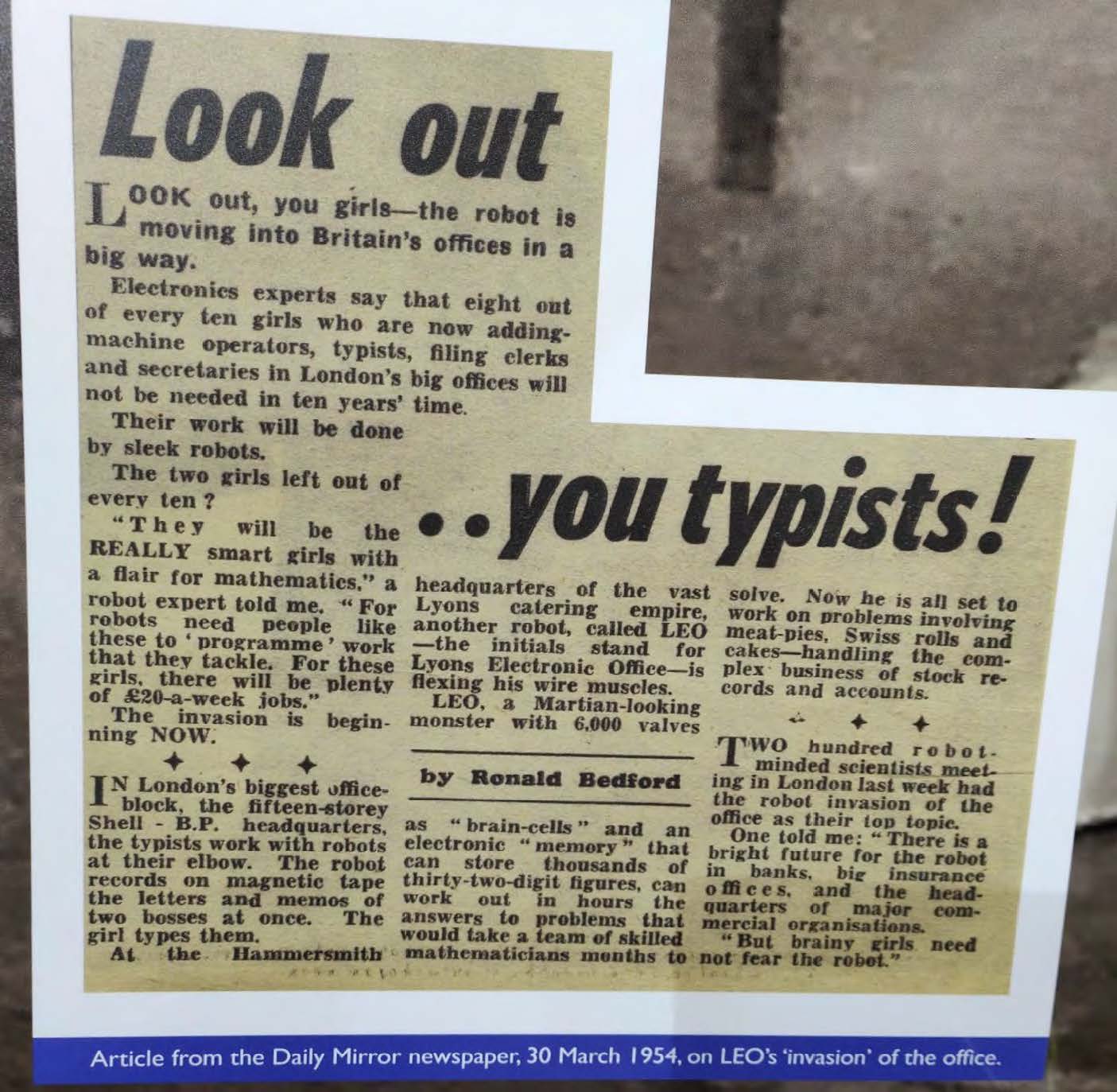
I note the gender stereotyping in this article – a lot has changed since the 1950’s!
The assumption is that “sleek robots” will invade the workspace and displace the work done by all but the “really smart girls”, who will be programming the robots. It assumes that administrative work will disappear and people currently doing that work will become unemployable.
What happened?
Computers did invade the workplace. Rather than displacing employees, computers enabled a very broad set of adjacent possibles, the organisations adapted to the emerging reality and a huge number of jobs that were beyond the imagination of those writing the article became possible. Data analysts, word processing specialists, code writers, systems architects, help desk operators etc. The system reorientated and accommodated the adjacent possibles, mass unemployment was averted.
Today is a great time to be entering the workforce
- Organisations will change and adapt – or become obsolete.
- For any role that is displaced by AI, the growing set of adjacent possibles provides the next opportunity.
- This set of adjacent possibles is growing faster than the number of roles that will be displaced.
- Anyone (including enthusiastic vendors) claiming predictive capability of the future of your sector is fooling themselves (or you). Time will show that some will make ‘accurate predictions’ but this is a function of probability not insight.
- Those who engage in the changing environment (explore adjacent possibles) will increase their probability of creating new value. Those who defend the past won’t.
- Organisations who hire people who are intelligent, hardworking and curious will build adaptive capacity faster than those who hire for the skills of the past.
The AGLX Adaptive Strategy framework has been designed with this in mind.
Adaptive Strategy:
- is built for organisations that choose to adapt from where they are now rather than defend the past.
- helps organisations navigate into emerging opportunity rather than retreat from disruption.
- does not rely on false certainty, it is designed to work in conditions of genuine unpredictability.
- encourages active exploration of what is emerging, not passive defence of what exists.
- supports building the human capability needed to thrive in a fast-changing landscape
If your organisation is ready to move toward opportunity and explore adjacent possibles, instead of hiding from disruption, get in touch to find out how Adaptive Strategy can support this process.