

He Scored the Simulators, Studied the Limits, and Sketched an Adaptive Agent
Pick the winner before the data comes in
In the mid-1970s the Air Force had two prototype fighters, the YF-16 and the YF-17, and a pile of computer programs that claimed to know which one would win in the air. Every contractor and every office showed up with its own simulation, and every one of them said its model was the best. Fifty years later, the labs racing toward super intelligence say much the same about theirs.
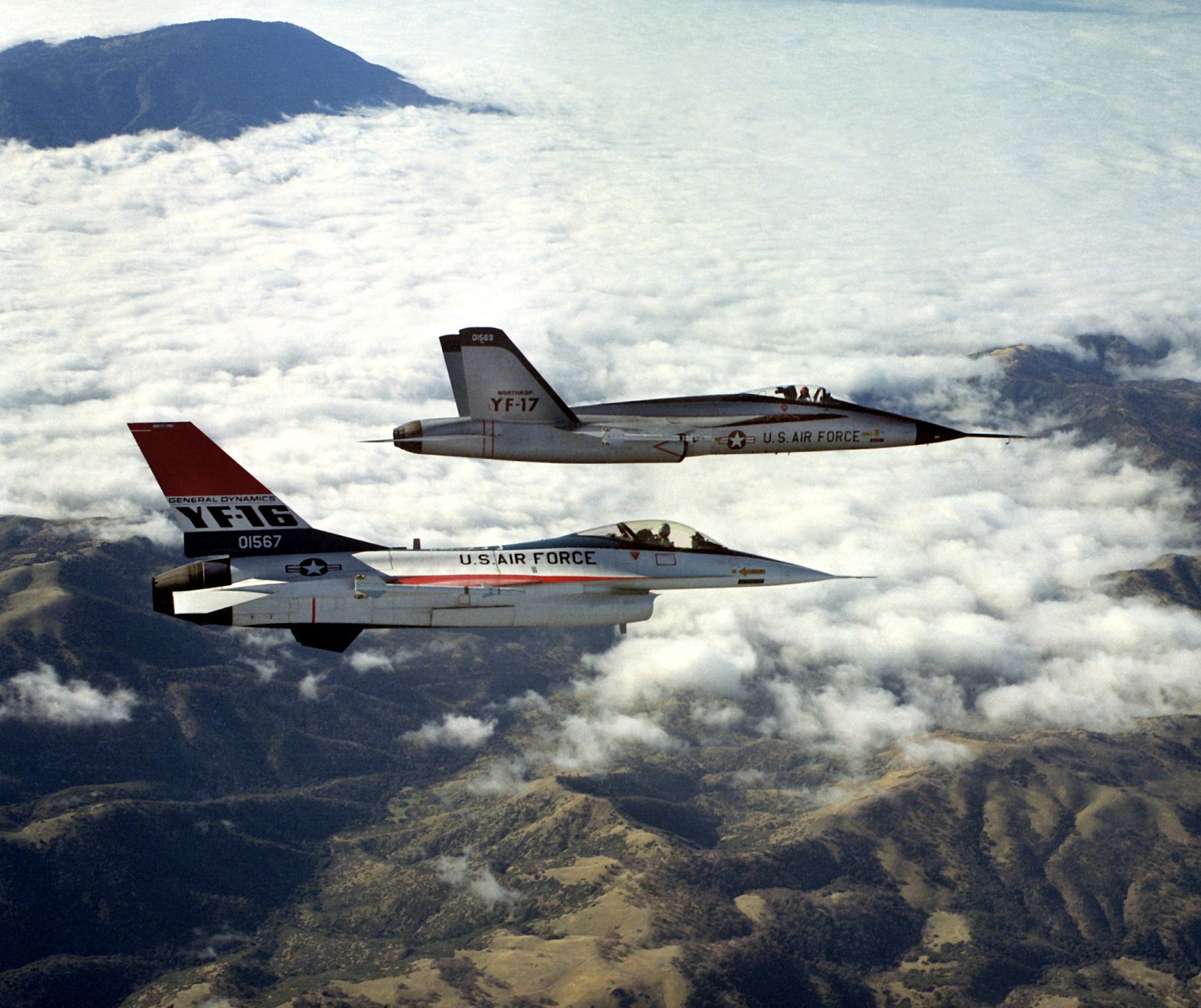
John Boyd’s answer was to run all of them. “Christ, it’s only the electric bill anyway,” he told Marine officers at Quantico in 1989.
Then he added a catch. “You tell me which one’s the better airplane before we run the flight data. We’re going to find out what the predictability of the program is, if it’s so damn good.”
So the modelers made their calls, the airplanes flew, and Boyd scored the programs against the flight data. “In some areas they were right, in other areas they were wrong … they couldn’t understand why they were wrong.” He went after the misses. What was missing from those programs, he said, “what people hadn’t thought of before,” led to many of the ideas in Patterns of Conflict (Brown, Snowmobiles and Grand Ideals, pp. 92–93).
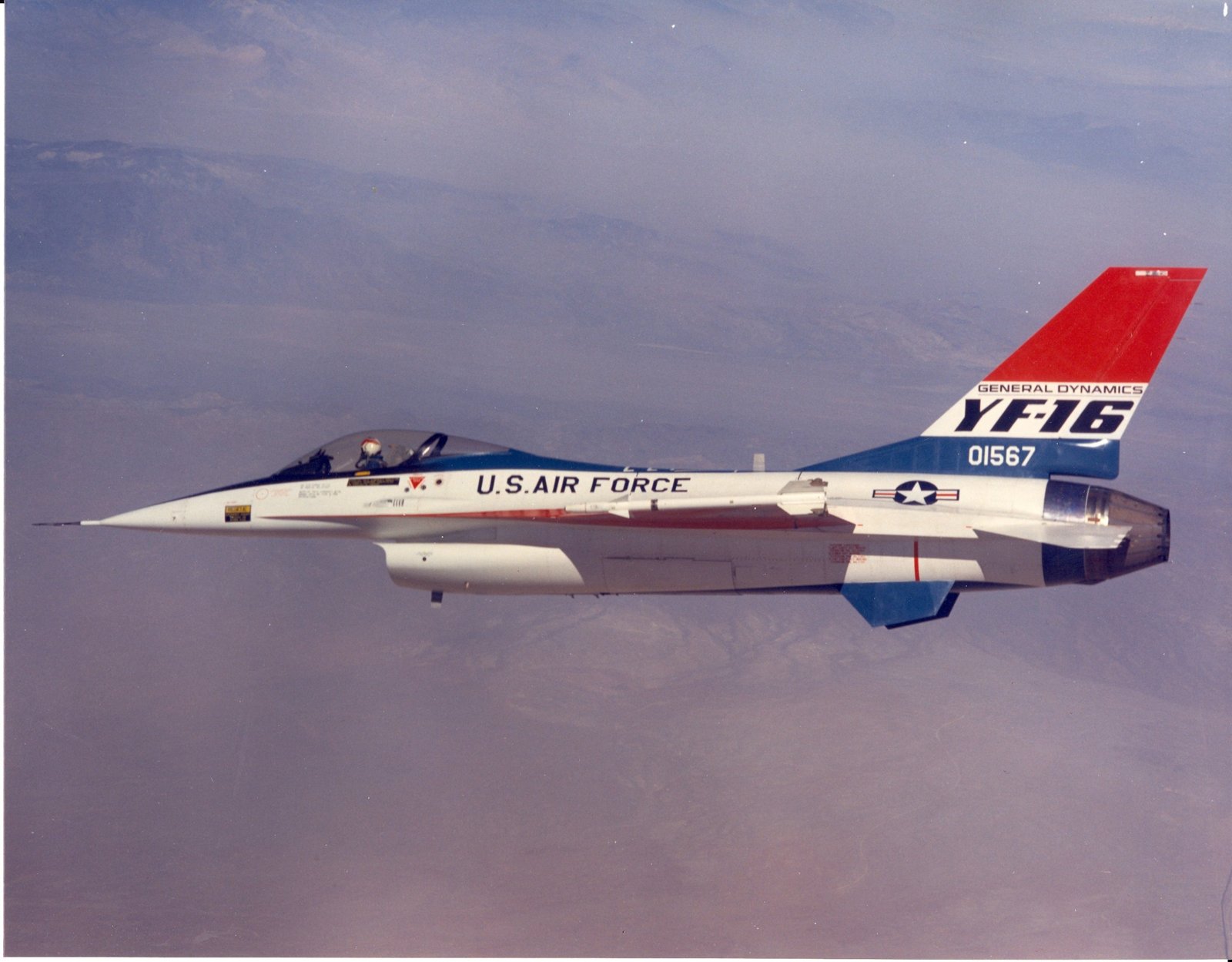
Today an AI (SI) lab would call that out-of-sample evaluation. You train the model on one set of data, you lock in its prediction, and you test it against data it has never seen. Boyd did it with two prototype fighters and a stack of computer programs, and then he mined the errors for new ideas.
Why does that matter now? Because the people building super intelligence, and the people putting AI into fighters and drones, are asking the question Boyd asked of those programs. How good is the model when the world does something the model has never seen?
What Boyd was, and was not
To be clear, Boyd was not an SI researcher. I searched his papers from the Marine Corps History Division, and he never uses the term “artificial intelligence” in his own briefings or notes. The phrase reaches his papers only as the subtitle of a book on his source list. He never built a machine meant to think, and no briefing of his takes machine intelligence as its subject.
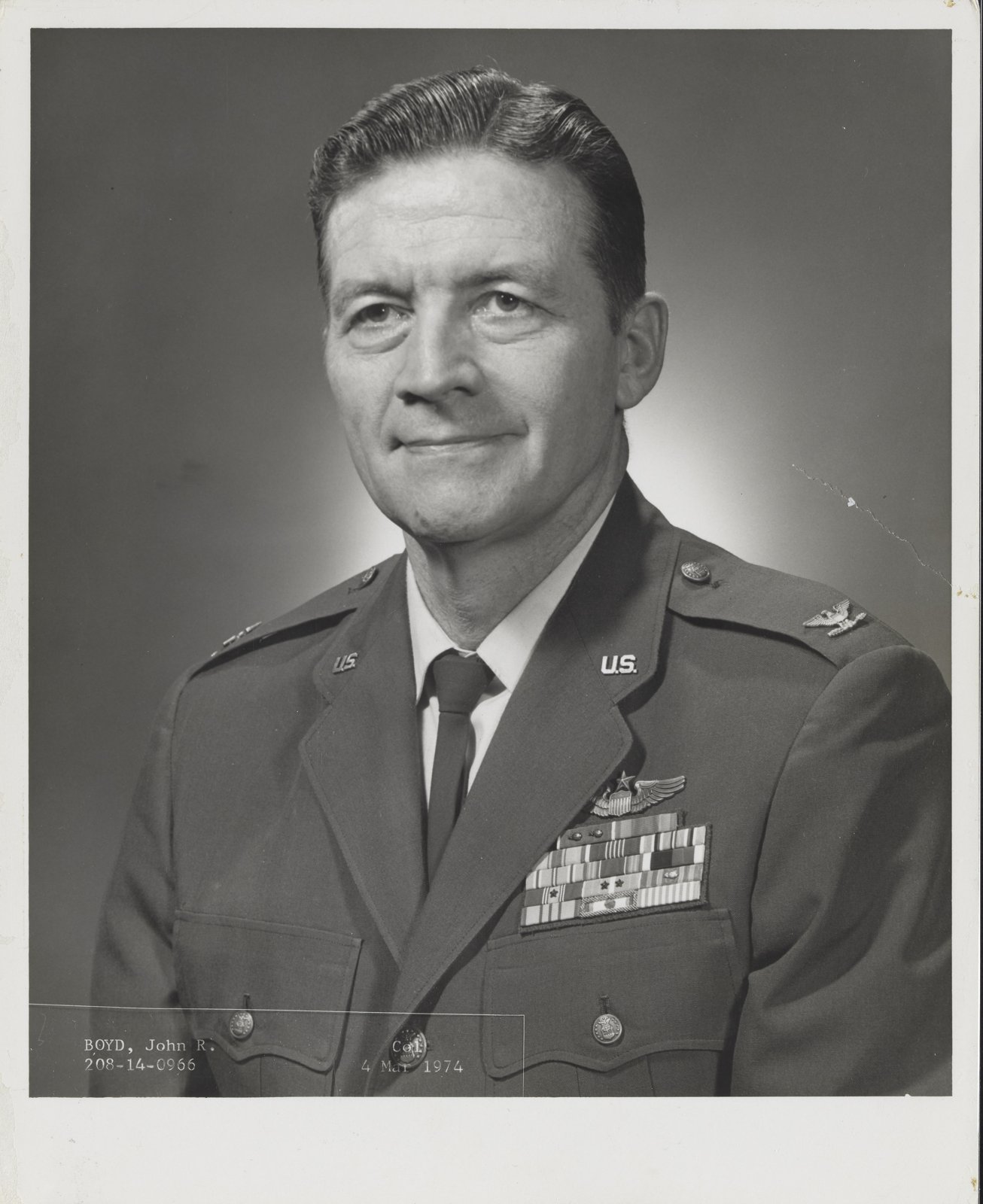
But he worked near the field in three ways. He used the computer as a tool and tested what it told him. He studied the limits of formal systems, the same ground on which the big arguments about machine intelligence were fought. And he sketched an adaptive agent.
The honest label is this. Boyd was a theorist of adaptive intelligence who used the computer as a tool, owned and marked up books from the early AI debate, and kept his eye on the limits.
He also asked a question that sits close to the one SI researchers ask. In a 1977 interview he described the time after his Aerial Attack Study, around 1960, when he worried it might be “a flash in the pan.” He wanted to know how he had done it so he could do it again. “I tried to understand the way I thought so that the process inside itself could do better later on” (USAF oral history, p. 246). Read with today’s science, that reads like the search for a model of his own thinking that improves itself. He pointed that question at himself, and later at people and organizations. He never pointed it at a machine.
One: the computer as a tool
Boyd says he came up with Energy-Maneuverability (E-M) theory as a student at Georgia Tech (oral history, p. 88). Proving it took a computer. At Eglin in the early 1960s he teamed with the mathematician Tom Christie. “Tom had access to an IBM 7094 computer and I had to find a way that we could use this big computer,” Boyd said. “So we started writing out computer programs. It took awhile to debug them and get them straight” (p. 101). When the bureaucracy would not give him machine time, he took it. “I can steal computer time on any computer you have in this whole command and you would never know it if I did not want you to” (p. 112).

E-M theory turns an airplane into energy. Altitude is stored energy and airspeed is moving energy, and the airplane that can gain or shed energy faster than its opponent has the edge. Two lines carry it. Energy height, Es, is altitude plus the energy of speed:
Specific excess power, Ps, is how fast that energy height changes:
Here h is altitude, V is airspeed, g is gravity, T is thrust, D is drag, and W is weight. The 1966 E-M report gives the same relationship (Boyd and Christie, Energy-Maneuverability, p. 43).
There is a detail in that report that SI people will recognize. To fly the best climb paths, Boyd and Christie ran the “Bryson-Kelley Steepest Ascent Optimization Program.” The report describes it as “an iterative scheme which begins with any non-optimal path and proceeds to derive a slight improvement each iteration” (pp. 39, 50). That is gradient ascent. Take a small step in the direction that improves things most, then repeat. In 1990 the Berkeley operations researcher Stuart Dreyfus argued that backpropagation, the method that trains today’s neural networks, is the same gradient procedure Kelley and Bryson worked out for flight paths, rediscovered and renamed by the neural-network people.
E-M theory is powerful, and it is a closed system. It describes the airplane. Nothing in the equation describes the person flying it or the person flying against it.
The Navy said so early. On September 10, 2025, I sat down with Dan Pedersen in his home to record an episode of No Way Out. Dan founded TOPGUN in 1969, and he tells this story in his book, Topgun: An American Story (pp. 144–145). That year, at an Air Force conference at Tyndall Air Force Base, two of his instructors, Mel “Rattler” Holmes and Jerry “Ski” Sawatzky, told Boyd that E-M theory was incomplete. It left out the most important factor of all, “the skill, heart, and drive” of the pilot in the cockpit. When we talked, Dan’s view was that Boyd was strong on technology and on energy relationships, and that he gave too little weight to the one variable you cannot fully put into numbers, the pilot. They were right. Boyd kept E-M theory and went looking for what it left out. The O-D-A loop shows up in his notes around the YF-16 and YF-17 flyoff, and from there he spent the rest of his life on adaptive systems: people, organizations, and adversaries that learn.
Here is where I want to go with this. Energy still shows up in SI research on air combat. Some papers build it straight into how they constrain and score their agents, the way İşci and Koyuncu do with “energy budgets” (AIAA SciTech, 2022). Those agents learn by flying, which is a step in the right direction. But they learn inside simulators, and a simulator is a closed model of the airframe and the fight. That is the YF-16 problem all over again. The adaptive nature of the SI in these aircraft and drones has to match an adaptive agent, the kind Boyd sketched, and it has to be scored against a world it has never seen.
Two: the limits of formal systems
At the center of Boyd’s last major briefing, The Conceptual Spiral, sits a list of scientists and what they found. One row reads “Godel/Tarski/Church/Turing/et al (1930’s . . .),” against “Incompleteness/undecidability in mathematics & logic.” A few rows down, Gregory Chaitin and Charles Bennett get a row of their own, “Incompleteness/incomprehensibility in information theory” (A Discourse on Winning and Losing, p. 336).
Let me unpack that a little bit. In the 1930s Gödel, Tarski, Church, and Turing showed that any consistent formal system rich enough to do arithmetic has true statements it cannot prove, and questions it cannot settle from the inside. Turing reached the same wall from a different direction. He imagined a machine that could compute anything computable, and then he proved there are questions that machine can never answer. That machine is the idea behind every computer you own. Decades later Chaitin carried the same limits into information theory.
Boyd knew Turing’s work. When he briefed the Conceptual Spiral, he stopped on him: “Many of you people have had computer science and obviously heard of the Turing machine and all that work that Turing did. How many people here have heard of Turing? I’m sure many of you have” (Brown, p. 575). Andrew Hodges’s biography, Alan Turing: The Enigma, sits on Boyd’s 1994 list of sources (MCHD 110215 p.6). His notes hold a 1988 Nature article on the Turing machine and the halting problem, underlined line by line (MCHD 111470 pp.57–58).
One undated notebook page puts the computer pioneers and his loop on the same short list: “Relate to SET. Von Neuman / Turing. Intelligence Community. Impact of SET on C and C (CME). OODA Loops” (MCHD 111456 p.17). SET is his shorthand for science, engineering, and technology.
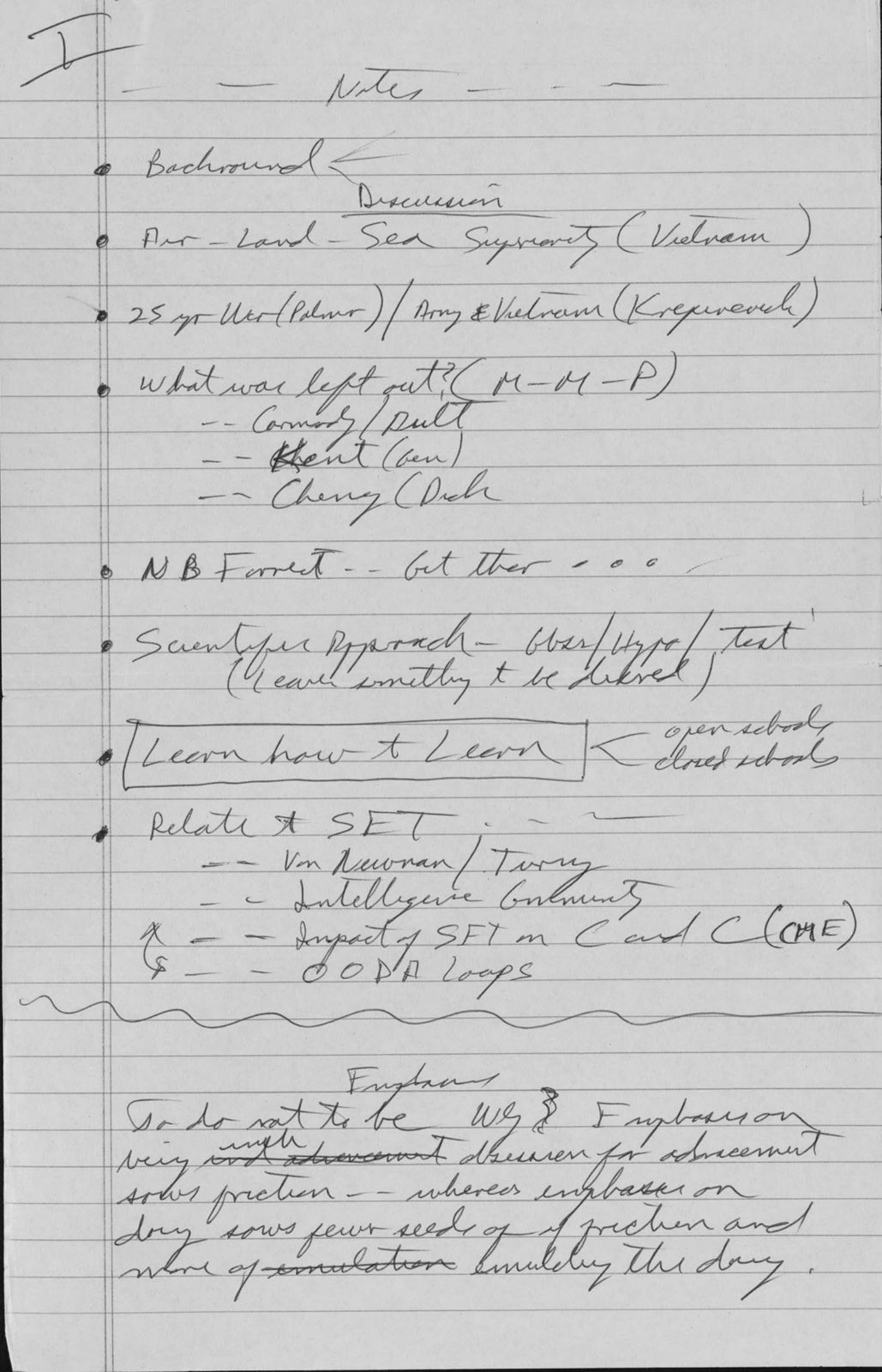
Boyd pulled the limits into one sentence he kept coming back to. Gödel’s incompleteness theorems, Heisenberg’s uncertainty principle, and the second law of thermodynamics, taken together, show “we cannot determine the character or nature of a system within itself. Moreover, attempts to do so lead to confusion and disorder” (Discourse, p. 283).
Then, in the Conceptual Spiral, he carried it one step further in what he called the Grand Message:
“Moreover, we neither have nor can we create beforehand a supersystem that can forecast or predict the kind of systems we will evolve in the future to represent or deal with that reality more completely or more perfectly. Furthermore, such a supersystem can neither forecast nor predict the consequences that flow from those systems that we create later on. Going even further, we cannot determine or discern the character or nature of such systems (super or otherwise) within themselves.”
A Discourse on Winning and Losing, p. 340
Boyd’s supersystem is a system that would forecast every system we build after it. He is talking about prediction, and he says nobody can build one. The industry’s word today is super intelligence. Boyd never wrote about SI, and I am not putting words in his mouth. But whether he meant it so or not, the Grand Message is a statement about every closed machine. No system can forecast the systems that come after it, and no system can determine its own character from within.
The conservation of information
This is the part of having access to Boyd’s work that made me stop and think.
In a notebook that is probably from the early 1990s (the dated pages around it run from 1991 to 1993), Boyd reads Gregory Chaitin, the IBM mathematician who recast Gödel in terms of information. As Ian Stewart put it in the Nature piece Boyd marked up, “the theorems deducible from an axiom system cannot contain more information than the axioms themselves do.” Boyd wrote that Chaitin’s proof “seems similar to the idea that my snowmobile cannot have more information than the domains from which it was derived” (MCHD 111470 p.2).
The snowmobile is Boyd’s famous example from Destruction and Creation. You pull the skis off a skier, the outboard motor off a boat, the rubber treads off a toy tractor, and the handlebars off a bicycle, and you put them together into something new. Here he asks a harder question about it. Can the snowmobile know more than the parts it came from?
His answer, a few pages later, is boxed in his own hand:
“Any evolved system/schema cannot have more energy/information than the systems or sources from which it was evolved.”
Then he goes one step further:
“In our real world any system we design or create must have less energy or info than the source from which it was created.”
MCHD 111470 pp.21–22
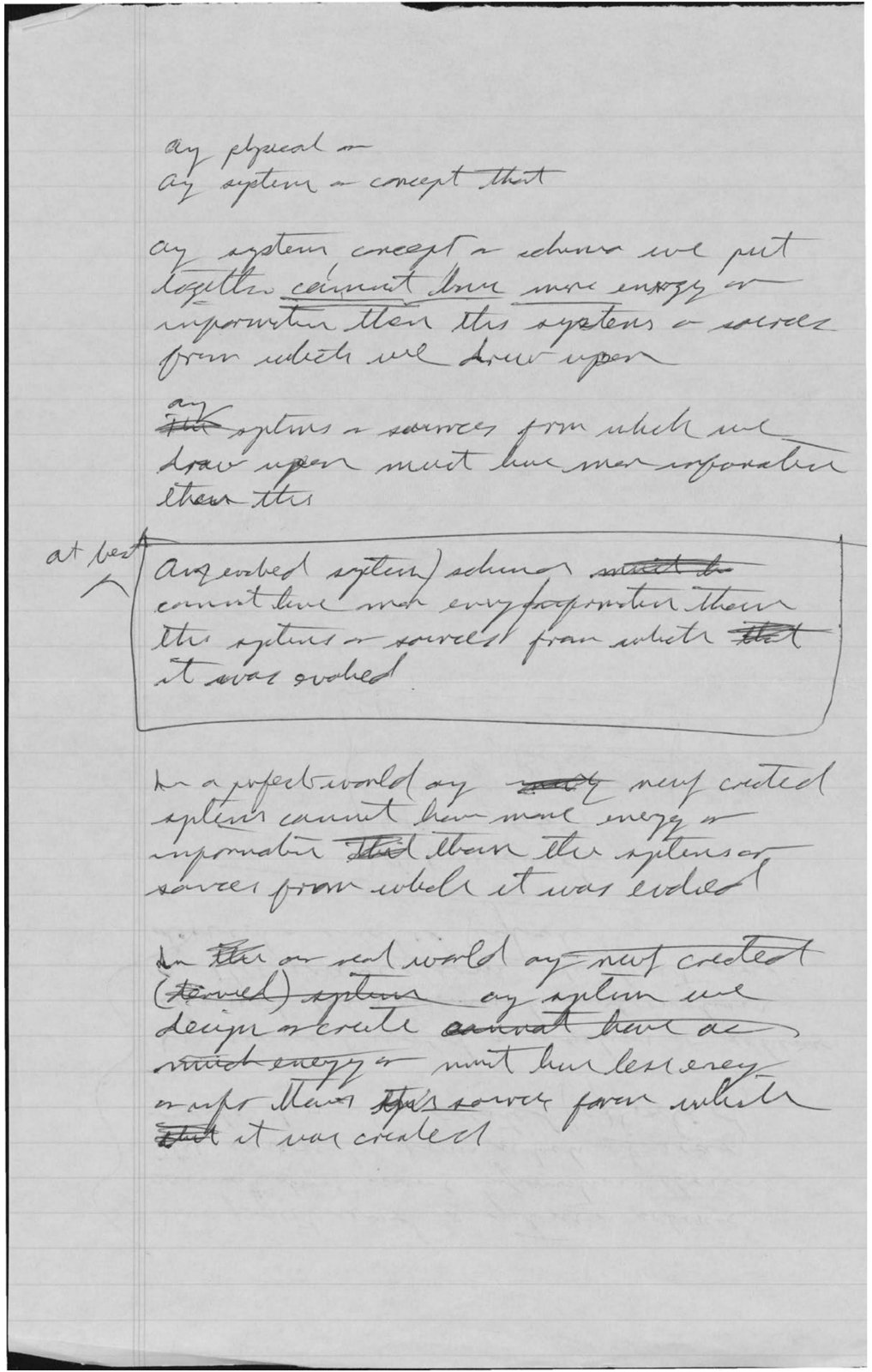
In a perfect world you break even. In the real world you lose some on the way.
Now be specific about which SI we mean. Take a model trained once on a fixed body of text. It cannot hold more than its sources, and by Boyd’s real-world rule it holds less. Now train the next model on that model’s output, and the next one on that. In 2024, Ilia Shumailov and colleagues reported in Nature that models trained this way lose the rare cases at the edges first, and over generations they drift toward a narrow, distorted picture of the world. They call it model collapse.
The same year, Matthias Gerstgrasser and colleagues showed the way out. When fresh real data keeps arriving alongside the synthetic data, instead of being replaced by it, the collapse goes away. Boyd had a phrase for that.
Pair the notebook pages with the Grand Message and you get his own argument for why a closed model drifts away from a changing world:
“People using theories or systems evolved from a variety of information will find it increasingly difficult and ultimately impossible to interact with and comprehend phenomena or systems that move increasingly beyond and away from that variety—that is, they will become more and more isolated from that which they are trying to observe or deal with, unless they exploit the new variety to modify their theories/systems or create new theories/systems.”
A Discourse on Winning and Losing, p. 340
“Exploit the new variety.” That is Gerstgrasser’s fix, in Boyd’s words, decades earlier.
That is the center of this whole piece. A closed system feeds on what it already has and runs down. An open system takes in new variety from the world and rebuilds itself. Boyd said it plainly in The Strategic Game: “Living systems are open systems; closed systems are non-living systems” (Discourse, p. 283).
To be fair to Boyd, these pages say nothing about computers or language models. Applying them to AI is my reading, and I think it is the right one.
Three: he sketched an adaptive agent
This is the big one.
Probably in the summer of 1975 (the page sits between pages dated 2 and 7 August), a year before Destruction and Creation, Boyd wrote a page in his notebook that reads like an AI research proposal. His engine of induction and deduction, he wrote, “suggests maybe we can develop a mathematics with both these features then: Program such a math logic into a computer. Place fundamental constituents into computer storage. Use Entropy Law as switching mechanism.” And then the line that matters most: “When adaptability becomes less than rate at which environment changes then Paradigm shift become necessary” (MCHD 111449 p.11).
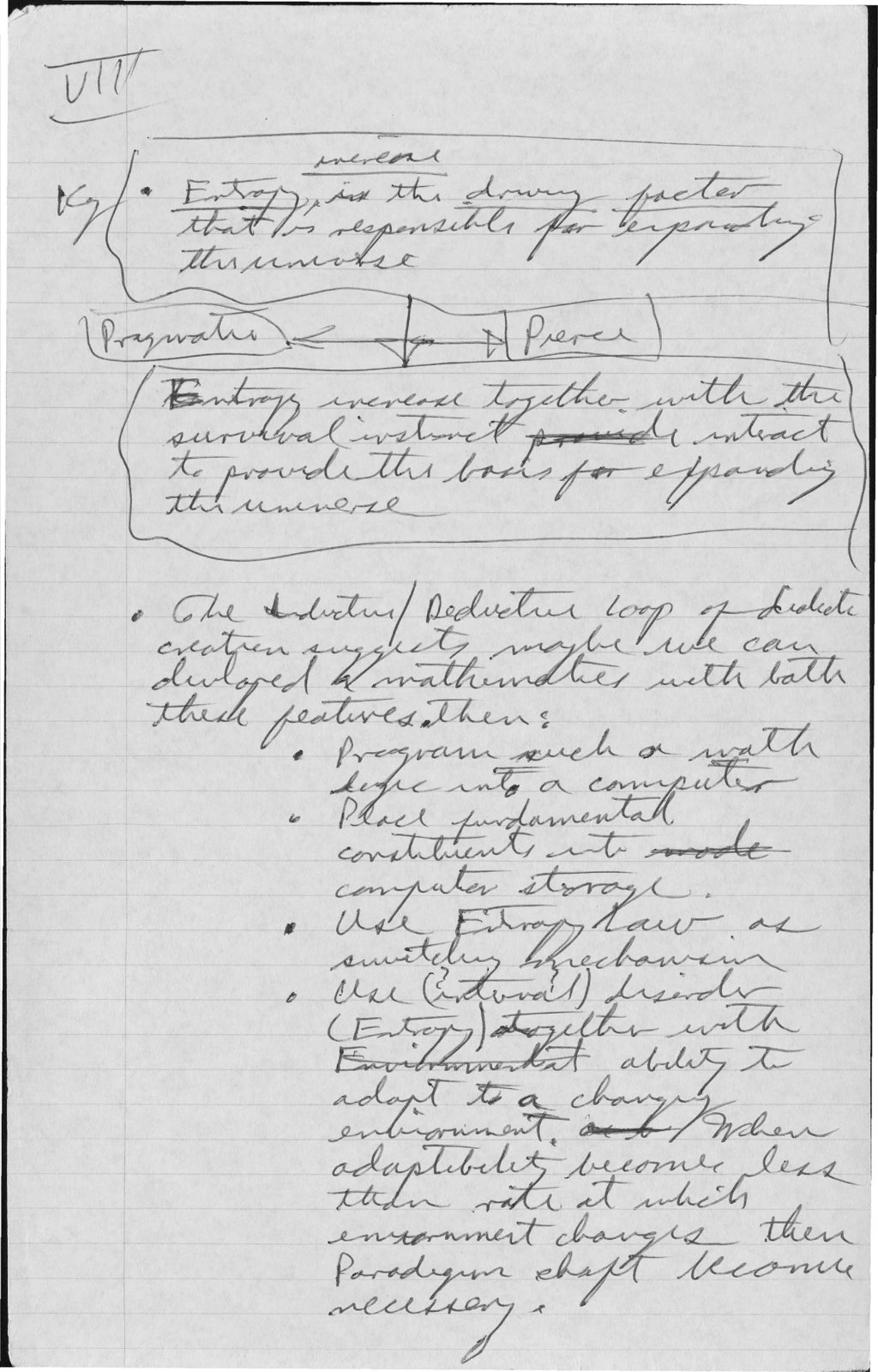
Read that last line slowly. When the world changes faster than you can adapt, you have to tear down your model and build a new one. That is the condition every learning system lives under, and in 1975 Boyd wrote it down on a notebook page. He never built the program. Four bullets in a notebook is as far as it went.
In 1995 he sketched what he had been chasing. The OODA loop sketch in The Essence of Winning and Losing has Observation taking in Outside Information, Unfolding Circumstances, and Unfolding Interaction with Environment. It has Orientation at the center, built from genetic heritage, cultural traditions, previous experiences, and new information, worked over by analyses and synthesis. It has Decision labeled “Hypothesis” and Action labeled “Test.” Feed forward runs from Observation to Orientation to Decision to Action. Feedback runs from Decision and from Action back to Observation. Implicit guidance and control runs from Orientation out to Observation and to Action. And Action meets the world as Unfolding Interaction with Environment, which comes back in through Observation.
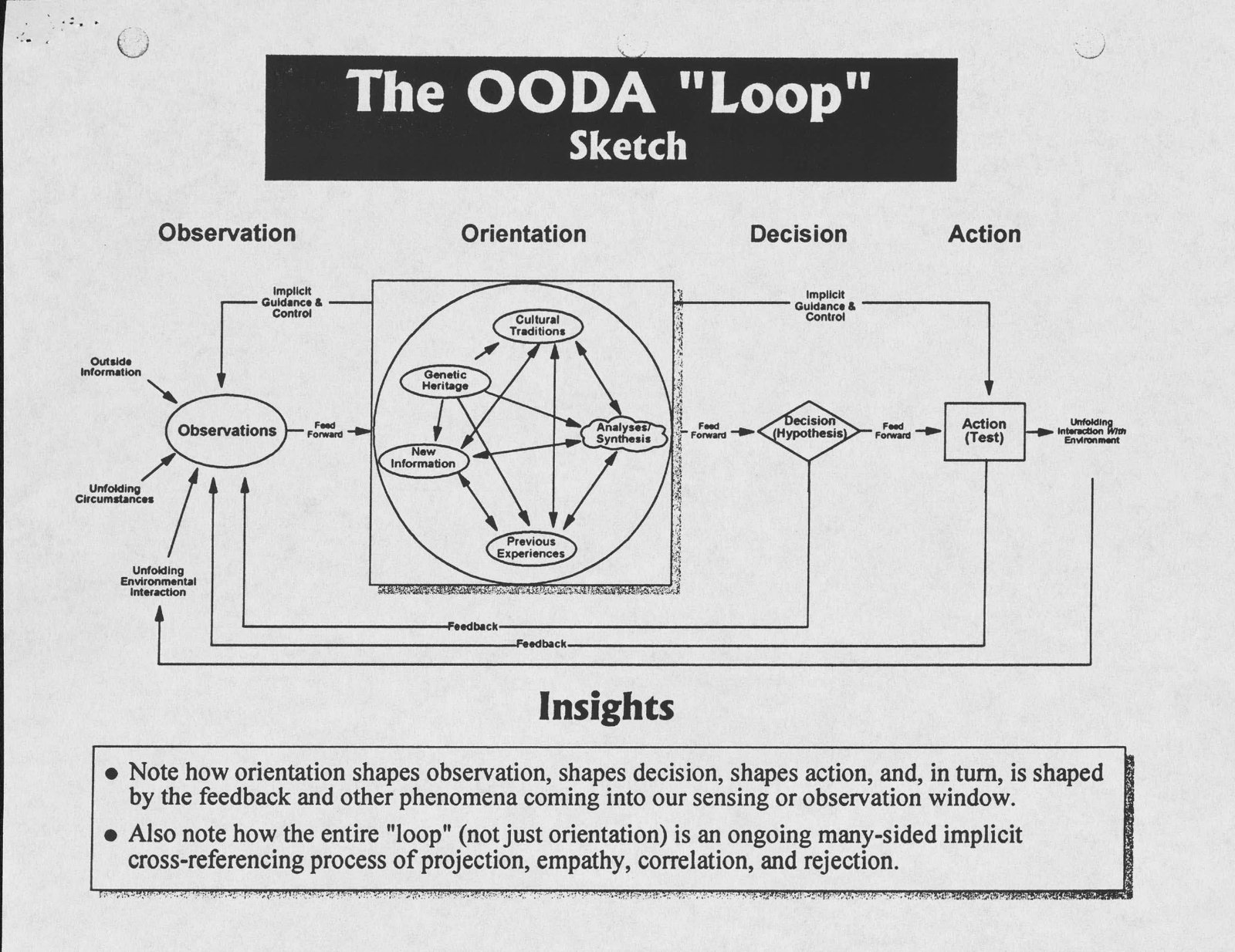
Look at what that adds up to. It has sensors, Orientation at the center shaping everything else, hypotheses tested against the world, and feedback. An AI engineer today would recognize the outline of an agent architecture. When Karl Friston, the neuroscientist behind the free energy principle and active inference, saw Boyd’s 1995 sketch, with Decision labeled “Hypothesis” and Action labeled “Test,” he said on No Way Out, “So this is isomorphic with active inference” (recorded 15 April 2026). In Friston’s language, Orientation plays the part of the generative model. Active inference, reinforcement learning (a cousin of active inference), and anything built around a world model all live in the neighborhood of that sketch.
Now compare that with the OODA loop most people learned. The linear, four-step decision-making process runs observe, orient, decide, act, and feeds straight back into observe. It is a snake eating its own tail. Orientation is one box in a row, and it never gets updated. There is no second loop where the world changes the model. It is a closed loop. It is not an adaptive agent, and if you build AI on that picture you get a machine that cannot tell when the world has moved out from under it.
Boyd also warned us about the other trap. When command and control failed, he wrote, “The institutional response for overcoming these fiascos is: more and better sensors, more communications, more and better computers … This way of thinking emphasizes hardware as the solution” (Discourse, p. 219). Robert Coram reports that Boyd preached “People, ideas, hardware, in that order” (Coram, Boyd, 2002). In his own notebook he put it bluntly: “Machines don’t wage war, terrain doesn’t wage war, people do and they use their minds” (MCHD 111455 p.26). And in front of the Marines in 1989: “Do you want a bunch of goddamn automatons working for you down here? It doesn’t work” (Brown, p. 180).
So here is the test for super intelligence, Boyd style. Does the machine take in new variety from the world, or does it feed on its own output? And does it make the people around it more adaptive, or does it turn them into automatons?
What Boyd read
Boyd read the AI debate the way he read everything, widely and with a pen in his hand. His 1994 source list names Marvin Minsky’s The Society of Mind and George Johnson’s Machinery of the Mind: Inside the New Science of Artificial Intelligence (MCHD 110215 pp.6, 8). It names Howard Gardner’s The Mind’s New Science, a history of the cognitive revolution that runs from Turing and von Neumann to Minsky and Herbert Simon. It names Heinz Pagels’s The Dreams of Reason: The Computer and the Rise of the Sciences of Complexity and Chaitin’s own Information, Randomness and Incompleteness. His Patterns of Conflict sources list Jeremy Campbell’s Grammatical Man on information theory (Discourse, p. 209).
His shelf goes further. The finding aid’s list of his books shows Douglas Hofstadter’s Gödel, Escher, Bach and Roger Penrose’s The Emperor’s New Mind, both marked as annotated. Next to them sit John von Neumann’s The Computer and the Brain, Norbert Wiener’s The Human Use of Human Beings, and Feigenbaum and McCorduck’s The Fifth Generation: Artificial Intelligence and Japan’s Computer Challenge to the World.
So I keep pulling that thread. Hofstadter and Penrose landed on opposite sides of the biggest AI argument of their day, whether a machine running rules could ever be a mind. Boyd owned both books, and the finding aid says he wrote in both. I have not seen those notes yet. They are next on my list.
Boyd read cybernetics too. He listed Maxwell Maltz’s Psycho-Cybernetics in the bibliography of Destruction and Creation (Discourse, p. 324), and his annotated copy of F. H. George’s Cybernetics sits in his library. In a 1975 notebook he wrote of unifying induction and deduction “into a cybernetic (dialectic) loop” (MCHD 111449 p.12). My view is that any serious conversation about super intelligence should start with cybernetics. That is a story for another article.
Back to the simulators
Go back to the YF-16 and YF-17 programs for a moment. Every modeler believed his program. Boyd made each of them commit to a prediction, he let the world answer, and he went looking for what the programs had left out.
That is the posture we need with super intelligence. The question for these systems is less about how big the model is and more about how it stays open to a world that keeps changing. Does it take in new variety? Does it test its hypotheses against the world and change when the world says no? Or does it feed on its own output and drift, the way Boyd said every closed system does?
Boyd left us something more useful than a thinking machine. He scored the simulators, he studied the limits of formal systems, and he sketched an adaptive agent. If we want AI in our aircraft, our drones, and our organizations that can cope with a changing world, it has to match that sketch.
And it should not turn the people around it into automatons.
Sources
Archive. MCHD = John R. Boyd Papers, COLL/2062, Marine Corps History Division, Quantico, Virginia; item number and PDF page. Boyd’s library is cited from the collection finding aid’s book list.
- John R. Boyd, A Discourse on Winning and Losing, ed. Grant T. Hammond (Maxwell AFB, AL: Air University Press, 2018).
- Ian T. Brown and Frans Osinga, eds., Snowmobiles and Grand Ideals (2025), transcripts of Boyd’s 1989 Quantico briefings.
- John R. Boyd, USAF Oral History Interview K239.0512-1066 (1977).
- John R. Boyd and Thomas P. Christie, Energy-Maneuverability (Eglin AFB, 1966).
- Robert Coram, Boyd: The Fighter Pilot Who Changed the Art of War (2002).
- Dan Pedersen, Topgun: An American Story (2019), pp. 144–145.
- No Way Out, episode with Dan Pedersen, recorded 10 September 2025.
- No Way Out, episode with Karl Friston, recorded 15 April 2026.
- Ilia Shumailov et al., “AI models collapse when trained on recursively generated data,” Nature 631 (2024).
- Matthias Gerstgrasser et al., “Is Model Collapse Inevitable? Breaking the Curse of Recursion by Accumulating Real and Synthetic Data” (ICML 2024).
- Stuart E. Dreyfus, “Artificial Neural Networks, Back Propagation, and the Kelley-Bryson Gradient Procedure,” Journal of Guidance, Control, and Dynamics 13, no. 5 (1990): 926–928.
- İşci and Koyuncu, “Reinforcement Learning Based Autonomous Air Combat with Energy Budgets” (AIAA SciTech, 2022).
Image credits. YF-16 and YF-17 photos: U.S. Air Force. IBM 7094 console: ArnoldReinhold, CC BY-SA 3.0, via Wikimedia Commons. Featured image by AGLX, combining those photos; it is licensed CC BY-SA 3.0. Archive images courtesy of the John R. Boyd Papers, Marine Corps History Division.