

Science-based Answers to Build Flow
The Flow System™: The Evolution of Agile and Lean Thinking in an Age of Complexity
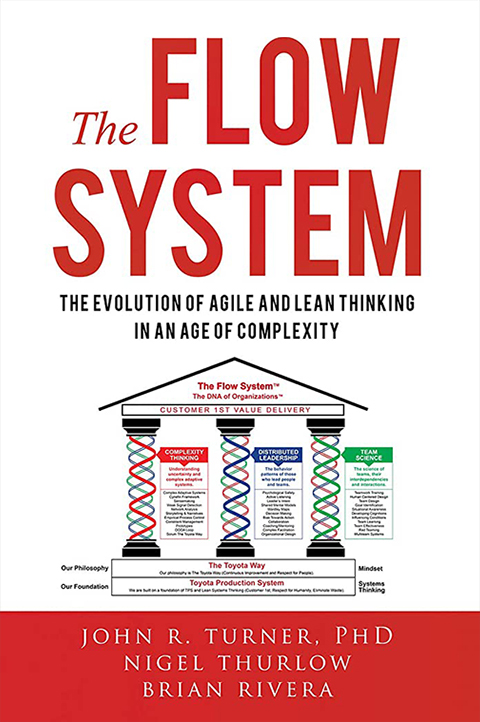
The Flow System™
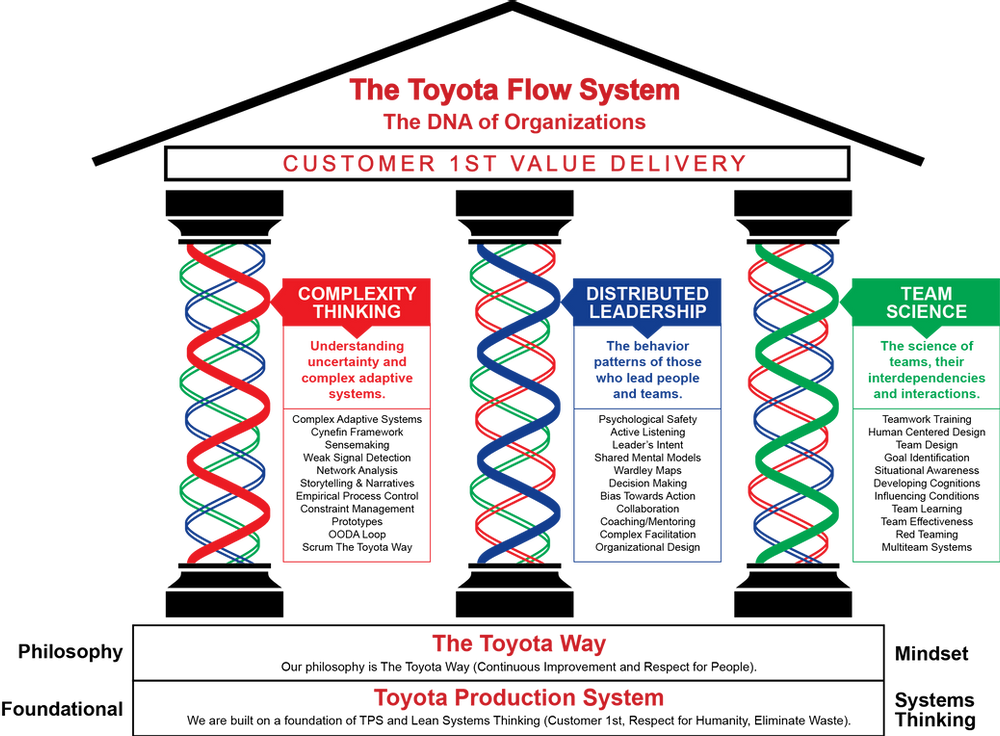
The Flow System™ is a holistic FLOW based approach to delivering Customer 1st Value. It is built on a foundation of the Toyota Production System (TPS/LEAN) and the new Triple Helix of Flow creating the DNA of Organizations.
A Flow-Based Approach to Organisational Value
The Flow System is a holistic approach for helping organisations deliver value in complex environments. It brings together lean thinking, complexity thinking, distributed leadership, and team science to support better flow across people, processes, and decision-making.
Developed by Brian “Ponch” Rivera, John Turner, and Nigel Thurlow, The Flow System builds on the foundations of the Toyota Production System and Lean, while extending the approach for modern organisations facing uncertainty, disruption, and complexity.
For AGLX, The Flow System is useful because it connects practical delivery with the human and organisational conditions that shape performance. It looks beyond process improvement alone and considers how teams collaborate, how leaders enable action, and how organisations create value for the customer.
Why Flow Matters in Complex Environments
In stable environments, organisations can often rely on standard processes, clear reporting lines, and predictable workflows. In complex environments, that is not always enough. Work moves across teams, decisions are affected by changing conditions, and value can be slowed by friction within the system.
Flow is the state where people can focus on doing meaningful work instead of fighting organisational constraints. When flow is disrupted, teams often experience delays, unclear priorities, duplicated effort, slow decisions, and poor handovers.
A flow-based approach helps organisations understand where value is being slowed, where people are being blocked, and where structures or processes need to adapt. This is especially important when organisations need stronger business agility without losing clarity, discipline, or customer focus.
Customer First Value
One of the central ideas within The Flow System is customer first value. This means that customer needs should guide direction, strategy, and improvement.
Customer value is not only about delivering outputs. It is about understanding what matters to the customer, reducing unnecessary friction, and shaping the organisation around the delivery of meaningful outcomes. When organisations lose sight of the customer, internal processes can become more important than the value they are meant to create.
A customer-first approach helps teams make better decisions about priorities, trade-offs, and improvement. It keeps the focus on quality, cost, lead time, and the experience of the people the organisation exists to serve.
The Flow of Value
The flow of value describes how work, decisions, learning, and outcomes move through an organisation. In practice, value does not move through a business in a straight line. It passes through people, teams, systems, constraints, approvals, conversations, and changing conditions.
Improving the flow of value means looking at the whole environment, not just one part of the process. It requires leaders and teams to understand where work is slowing down, where decisions are becoming disconnected, and where the system is creating avoidable friction.
This is where lean thinking remains important. Lean helps organisations identify waste, reduce delays, improve quality, and create smoother pathways for value delivery. The Flow System builds on this by bringing in complexity, leadership, and team dynamics as essential parts of organisational flow.
The Triple Helix of Flow
At the centre of The Flow System is the Triple Helix of Flow. This describes three interconnected strands that shape how organisations operate and adapt:
- Complexity thinking: understanding the wider environment, patterns, constraints, and uncertainty that influence how work gets done
- Distributed leadership: enabling leadership to emerge across the organisation, not only through formal roles or hierarchy
- Team science: applying evidence-based understanding of how teams coordinate, communicate, learn, and perform
These three strands are connected. Flow improves when teams can work effectively together, when leadership is shared across the system, and when people can respond intelligently to complex conditions.
Complexity Thinking
Complexity thinking helps organisations understand that not all challenges can be solved through fixed plans or linear processes. In complex environments, outcomes emerge from the interactions between people, systems, constraints, and context.
This means leaders need to pay attention to patterns, feedback, and changing conditions. Instead of assuming there is one correct answer, complexity thinking encourages organisations to test, learn, adapt, and adjust their approach as the environment changes.
Within The Flow System, complexity thinking helps organisations work with uncertainty rather than pretending it does not exist. It supports better decision-making when conditions are dynamic, interconnected, and hard to predict.
Distributed Leadership
Distributed leadership recognises that leadership does not only sit with formal leaders. In complex organisations, the people closest to the work often have important knowledge about constraints, risks, customer needs, and improvement opportunities.
When leadership is distributed well, teams are better able to act, respond, and learn without waiting for every decision to move through hierarchy. This does not remove the need for formal leadership. Instead, it creates the conditions for leadership to happen at the right level, by the right people, at the right time.
AGLX uses this thinking to help organisations build stronger decision-making capability, improve alignment, and create the conditions for people to contribute more effectively across the system.
Team Science
Team science focuses on how teams actually work. It looks at communication, coordination, shared understanding, trust, learning, and performance.
In many organisations, poor flow is not only caused by process issues. It can also come from unclear roles, weak communication, competing priorities, low trust, or teams working in isolation. Team science helps leaders understand these human factors and design better conditions for collaboration.
Within The Flow System, team science supports the practical side of flow. It helps organisations build teams that can coordinate more effectively, adapt under pressure, and stay focused on customer value.
Applying The Flow System in Practice
The Flow System provides a way to understand and improve how value moves through an organisation. It is especially useful for organisations dealing with complexity, slow delivery, unclear priorities, fragmented teams, or changing customer expectations.
AGLX applies The Flow System as part of a broader approach to adaptive strategy, leadership, risk, and organisational performance. Rather than treating flow as a process issue alone, we look at the system that surrounds the work. This includes leadership, team dynamics, complexity, customer value, and the conditions that either support or constrain action.
By applying The Flow System, organisations can develop greater business agility, reduce unnecessary friction, and build more adaptive ways of working.
A Practical System for Adaptive Organisations
The Flow System gives leaders a practical way to think about how value is created, slowed, and improved. It connects processes, people, leadership, and complexity into one approach.
For organisations working in uncertain or fast-changing environments, this matters. Improving flow is not just about doing work faster. It is about creating the conditions for teams to deliver better value, learn quickly, and adapt with purpose.
AGLX uses The Flow System, distributed leadership, complexity thinking, team science, and lean thinking to help organisations better understand how work moves through their environment and how value can be delivered more effectively.